The Events Industry Alliance (EIA) launched a campaign at the beginning of July urging UK and EU policymakers to prioritise the establishment of a Mutual Recognition Agreement (MRA) for the business events sector in future trade discussions. Our Magazine Manager, Manuel Fernandes, spoke to EIA’s trio of leaders about the need for this continental convergence.
The UK business events sector is a vital economic engine, hosting more than 1,100 trade shows and seven million attendees annually with an economic impact of around £10.9 billion (approx. €12.75 billion). With more than 100,000 jobs created across the country, the sector makes a significant contribution to regional and national economies. In 2023 alone, the sector grew by 17% – far outstripping the UK’s GDP growth of just 0.1%. “It is clear that the business events industry is extremely valuable to the UK economy and drives business travel to every part of the country but often our industry does fly under the radar. That is partly why the EIA is actively working to change that perception and lobbying for a strategic business events strategy, similar to the one recently announced by Ireland,” says Anna Golden, EIA Co-Director and CEO of the Association of Event Organisers. “One of the major issues has been that we fall between the cracks of diff erent Government departments and do not have one sole department advocating on our behalf. We have been working successfully over the last few years to build political support for the sector across Westminster and Whitehall.”
Almost five years after the official departure from the EU, the knock-on effects on the UK industries are still being felt across the board. In addition to set-up challenges and increased supplier costs, a recent ESSA survey reveals that 82% of business events suppliers believe that Brexit has negatively impacted their operations, with 67% reporting direct business losses. “It is clear that the Brexit scenario, and the following period of uncertainty, partnered with the pandemic, had a signifi cant bearing on the UK business events industry,” says Rachel Parker, EIA Co-Director and Director of the Association of Event Venues. “However, our members continue to create, build and host world leading business events, attracting domestic and international visitors and exhibitors across the UK.” While other creative sectors have received assurances of support and safeguards to tackle their obstacles, such as touring musicians, the events sector has remained largely excluded from the debate. Yet, “our recent report presented some positive findings; it concluded that by 2024, the number of exhibitions showed further recovery growing by 4% to reach their highest level since 2017. The average number of exhibitions per venue was also up compared to 2023 and the volume of trade exhibitions was up above pre-Covid levels,” Parker states.
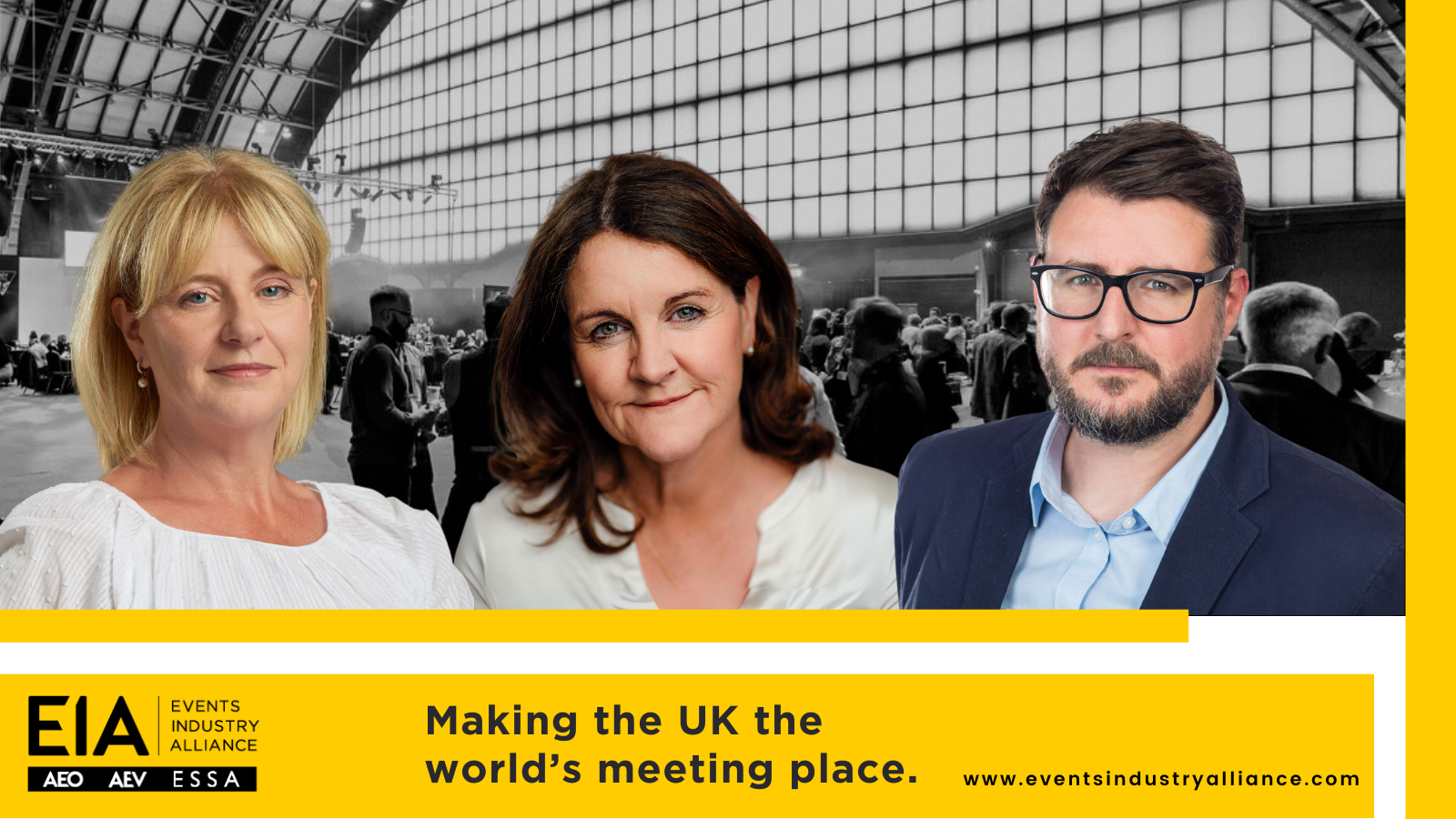
Our key informants for this report and EIA Co-Directors: Anna Golden, Rachel Parker, and Andrew Harrison.
According to various reports, European and British planners are now very anxious about value for money and destination support. Economic challenges, increased paperwork and tariffs can lead to a mountain of inflation throughout the supply chain. “We have found that economic pressures are driving destinations and venues to be more creative and competitive in the way they attract and stage major events,” says Harrison. “While the most cost-effective destinations may get a short-term boost as planners look for savings, venues that combine solid infrastructure with adaptability and partnership-driven approaches will remain highly competitive.” For EIA, in many cases, improved infrastructure can help level out production costs by reducing operational friction, increasing efficiency and offering integrated support services. “Excel London recently completed a €252 million expansion to improve its facilities, with a focus on sustainability and fl exible event spaces. Olympia London is investing €1.5 billion which will see a new international convention centre opening in 2026. Smaller venues in London continue to modernise and invest, including the Barbican, which has announced a €275 million investment programme. Similarly, ICC Birmingham and Manchester Central have both rolled out upgrades to improve connectivity, hybrid features and the attendee experience. These investments are not just about capacity; they are about higher quality support and services that justify the value in a challenging market,” explains Parker.

This is especially important when we hear countless stories of conferences that have been moved, cancelled or rescheduled to more reliable and stable destinations due to changing political trends and regional tensions. “While it is important to recognise that there are new challenges in the market, some of our members are excited about the new business. Excel London recently announced that it will host ten major international congresses in 2026 – a record for a single year that will generate £250 million (approx. €292.5 million) for London’s business economy. P&J Live in Aberdeen will host 375 events this year, all with a significant economic impact for the city and the region. Finally, ICC Birmingham has also won a number of medical congresses in 2026 and 2027, which points to the UK’s cherished opportunity as a destination for the sector,” Parker reassures. Finally, the rise of destinations in Asia and the Middle East to the top of international event rankings represents not only the economic vitality of these regions, but also the expansion of a global industry that is tangible to various sectors. This could be another strong argument for a closer working relationship between the UK and the EU. “In an increasingly multipolar market, standing still is not an option. The UK must ensure, as far as possible, that exhibitors enjoy frictionless cross-border operations. As we have seen in recent years, destinations that remove regulatory and mobility barriers gain market share, while those that add complexity lose it. That is why we have launched this campaign, because we need to act fast to position the UK as a reliable and accessible destination again,” concludes Anna.
Powered by Meeting Media Company, publisher of Headquarters Magazine (HQ) – a leading international publication based in Brussels, serving the global MICE industry and association community.
Since its founding in 1992, Meeting Media Group, publisher of Headquarters Magazine (HQ), has been a trusted guide and voice for associations and the global MICE (Meetings, Incentives, Conferences, and Exhibitions) industry.