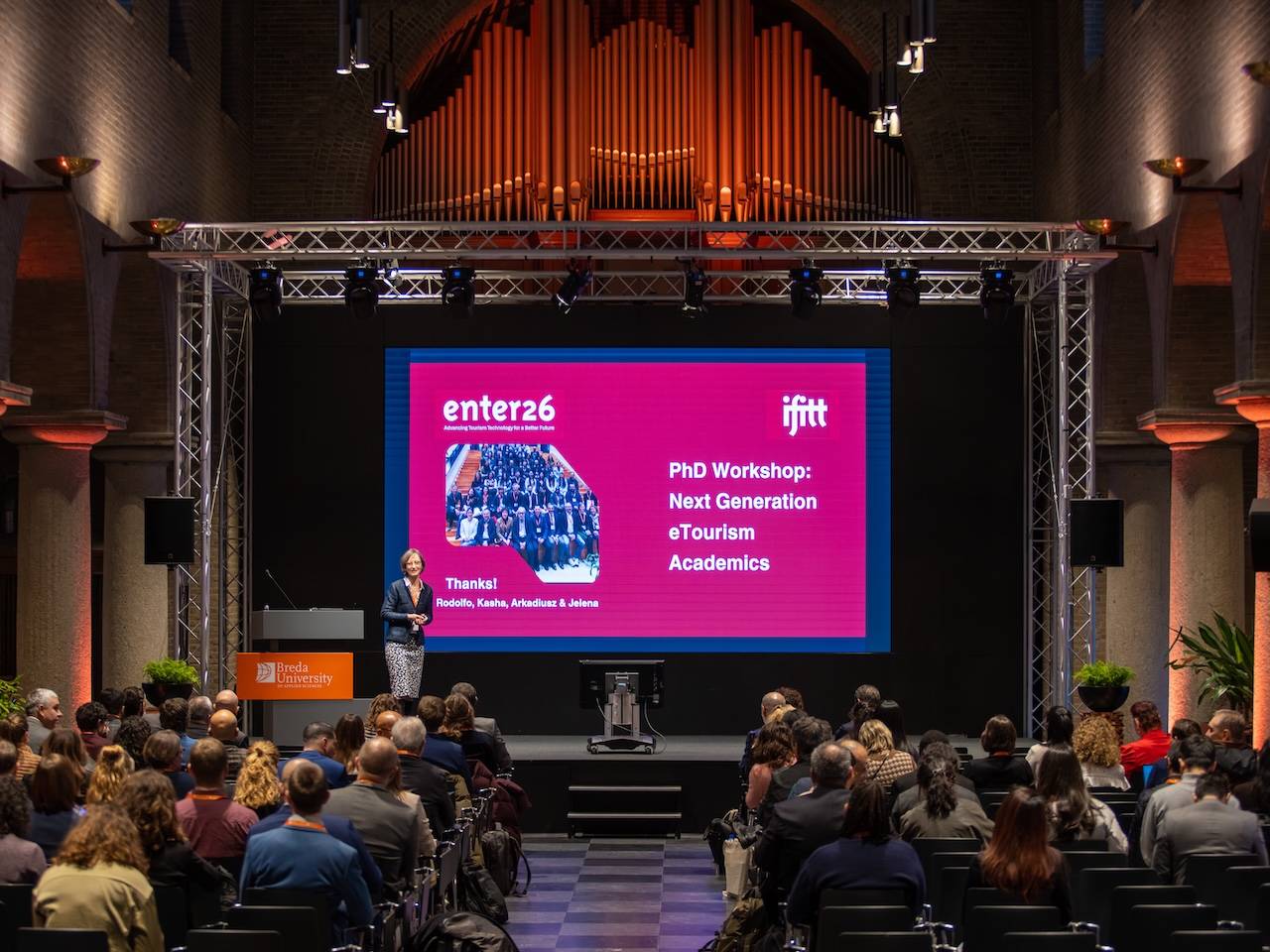
More than a sum of destinations and assets, tourism is becoming a playground for technology, from AI-driven recommendations to service robots. Yet for Stanislav Ivanov, President of the International Federation for Information Technology and Travel & Tourism (IFITT), the true measure of innovation is not about the gadgets themselves, but how they serve people, ethics, and sustainability. IFITT is an independent global community connecting researchers, professionals, and decision-makers in the sector, promoting responsible and human-centered adoption of information and communication technologies in tourism. Its ENTER Conference 2026, held in Breda, connected scholars and industry leaders to turn cutting-edge research into real-world solutions, shaping the future of travel and hospitality.
In this exclusive conversation, HQ spoke with Stanislav Ivanov – who is also Professor of Tourism Economics at Varna University of Management and Director of Zangador Research Institute – about the rise of AI agents, the human side of automation, and the ethical challenges facing the tourism of tomorrow.
IFITT is the leading independent global community for knowledge creation and dissemination in information and communication technologies in Tourism and Hospitality. Through its annual ENTER conferences, IFITT connects researchers and industry practitioners around a shared vision: that technology is a tool that must serve people, not the other way around. This ethos is evident in the topics and content of conference sessions and workshops, which are framed not as uncritical showcases of technology deployment in the tourism context but as spaces to examine fairness, inclusion, human agency, transparency, and data sovereignty as preconditions for ethical adoption of technologies at scale.
The PhD Workshop, held prior to the main conference, guarantees intergenerational knowledge transfer, cultivating researchers who integrate ethical considerations from the outset. Participation in the conference, alongside keynotes from industry leaders and policymakers, ensures that our research remains relevant to tourism practice, while research insights feed directly into destination management, technology design, and corporate strategies.
Technologies evolved in the 30 plus years of IFITT and with them the scope of papers at our ENTER conferences – from website evaluation, booking and recommender systems, through social media and mobile apps, to artificial intelligence and robotics. However, IFITT’s mission has always been to connect industry and academia in the pursuit of creating greater value for tourists, tourism businesses and all other tourism stakeholders through the implementation of digital technologies in the sector.
Connecting industry and academia can be challenging, as these two worlds often speak in different languages and with distinct priorities and time horizons. IFITT seeks to bridge this gap in different ways. First, we ensure that tourism and technology professionals are consistently present at the ENTER conferences and actively contribute as keynote speakers, panellists, or in delivering practical workshops (e.g. on the use of specific technologies). Their participation not only fosters collaboration between industry and academia, but also enhances the practical relevance of tourism technology research.
Second, we view technology research not merely as theoretical output, but as real-life research with actual technologies. This is why participants at ENTER conferences can see, use, and interact with robots, AR/VR, and other innovations, often provided by local industry representatives. Third, in research papers we place particular emphasis on their managerial implications, facilitating the translation of findings into actionable recommendations for businesses.

eTourism research is now a vast domain. However, I believe there are some areas in which research is still in its infancy and where further effort is required. Most notably, this concerns the economics of digital technologies in tourism and hospitality. From an economic and financial perspective, technologies are assets, and tourism managers and owners need to see their contribution to companies’ bottom line in order to justify investment. Studies need to be directed towards the automatability of tasks and jobs in tourism, as well as on the substitution (replacement), enhancement (augmentation), transformation, and new task/job creation effects of technologies in tourism and hospitality. At the same time, customers may appreciate these technologies but may not be willing to pay much for technology-delivered services (e.g. automated hotels, room service delivery robots, robotic bars, etc.); hence, their willingness to pay for such services warrants further investigation.
Another major area concerns AI agents. The world is moving towards a robonomic economic system in which AI agents make and implement decisions and perform tasks on behalf of their owners. At present, they can write emails, respond to customer queries, and set prices, but in the future they will undertake many more functions and become regular economic actors, similar to humans and organisations. Therefore, we need conceptual and empirical studies to identify which tasks and decisions can be delegated to agents; what the most appropriate decision-making approaches are (e.g. human in, on, or out of the loop); the ethical issues that arise; the human dimension of automation, human–robot/AI collaboration, and more. AI agents will be one of the most important areas of research in tourism technology in the near future.
ENTER26, hosted by Breda University of Applied Sciences in the Netherlands, brought together researchers and industry leaders around the central theme of advancing tourism technology for a better future. Keynotes addressed the AI-driven transformation of travel – from smart tourism in the metaverse era and data governance challenges, to AI ethics and the complexities of conducting research in the field. Academic sessions focused on a broad range of topics highly relevant to the future of tourism, including smart tourism, digital co-creation of experiences, robotics in hospitality, the metaverse, blockchain, and social media, among others. Across all tracks, shared concerns emerged around ethical AI deployment, sustainability, equity, human-centred design, and the role of ICT in enabling regenerative tourism. The evolving digital skills requirements and future job profiles of tourism professionals were also discussed as a means of improving the industry’s competitiveness and attractiveness to talent.
The conference covered a wide range of interesting topics, and those on ethics, sustainability, education, resilience, and leadership showed that the successful implementation of AI and robots is not only about technology, but also about organisational processes, human values, and ethics.
The PhD Workshop is an integral part of every ENTER conference and takes place the day before the main conference. It provides PhD students not only with exposure to novel research methodologies, but also on how to cope with stress, organising managing time and activities during their studies, and addressing research ethics. Lecturers at the PhD Workshop are typically leading experts in their respective thematic fields/methodologies, while recent graduates also share valuable insights from their own PhD journeys. Mentoring early-career researchers is essential if future generations of tourism researchers are to conduct world-class research on innovative topics with high societal value in an ethical manner.

Both topics are essential to, and embedded within, our research. We believe that the implementation of digital technologies in tourism should be done ethically and responsibly, contributing to sustainable development. It is therefore no surprise that more than 10 presentations and two keynotes focused directly on sustainability and ethics in technology implementation (e.g. ethical leadership, ethical principles for responsible AI and automation, data for sustainable tourism, etc.). The same applies to research itself, which must also be conducted ethically. For this reason, the PhD Workshop at ENTER26 included a dedicated keynote on the implications of AI for research ethics in tourism, supporting PhD students and young researchers in the responsible use of AI.
ENTER26 showed that the age of AI agents and robots in tourism has arrived. These technologies are becoming increasingly capable over time and may help solve many issues in the tourism industry – labour shortages, low productivity, poor working conditions. Although some perceive these technologies as a threat to hospitality, they also offer significant potential benefits. That is why, ENTER27, to be hosted by Universidad Autónoma de Madrid, Spain, will pay more attention on AI agents and robotics, as well as their economic, societal, and sustainability impacts. From a research perspective, ENTER26 revealed that AI provides new tools and opportunities for research design, data collection, and analysis. Therefore, for ENTER27, we plan to expand the range of methodological workshops related to the ethical use of AI in research.
The future trajectory of IFITT is encapsulated in my presidential motto: Vision with ambition – Action with purpose – Value for society. We shall focus on expanding the organisation’s global reach by engaging researchers and practitioners from currently underrepresented regions, such as Eastern Europe, South-East Asia, Africa, and Latin America. We also intend to further strengthen the practical dimension of the ENTER conferences and increase the importance of managerial and policy implications of studies (alongside their theoretical contributions), in order to increase the societal and policy impact of IFITT and the ENTER conferences. Establishing synergetic partnerships with other leading tourism research organisations will ensure a shared vision and collaborative actions in advancing digital innovation in tourism for the benefit of society as a whole.
Powered by Meeting Media Company, publisher of Headquarters Magazine (HQ) – a leading international publication based in Brussels, serving the global MICE industry and association community.
Since its founding in 1992, Meeting Media Group, publisher of Headquarters Magazine (HQ), has been a trusted guide and voice for associations and the global MICE (Meetings, Incentives, Conferences, and Exhibitions) industry.