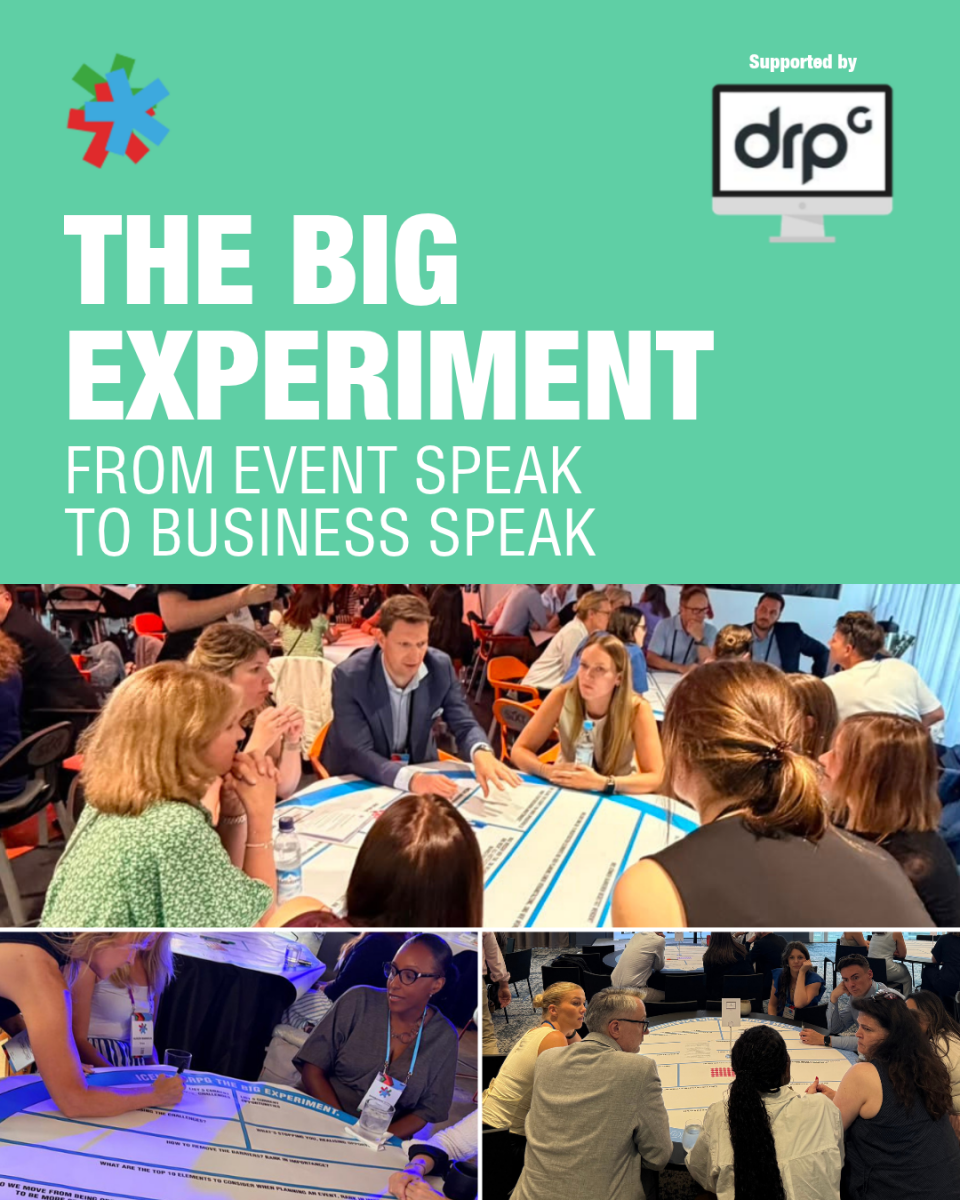
A study involving more than 400 senior corporate event professionals across the UK, Germany and the US identifies a common obstacle to demonstrating event ROI: the absence of clearly defined objectives and agreed measures of success from the outset.
More than 400 senior in-house corporate event professionals contributed to The Big Experiment: From Event Speak to Business Speak, a new whitepaper published by the International Corporate Events Network (ICEN), with support from creative communications agency DRPG. The research was conducted during ICEN's flagship events in July 2026 across the three markets, inviting participants to examine what prevents them from demonstrating return on investment and what needs to change.
Across all three countries, budget emerged as the most frequently cited challenge. However, the findings suggest that financial constraints are often a consequence of a more fundamental problem: the difficulty of demonstrating the business contribution of events. Without clearly established objectives, event teams struggle to identify what success looks like, let alone measure it afterwards.
The German participants were particularly direct about this gap, highlighting the absence of clearly defined objectives as a fundamental obstacle to measuring outcomes. In the UK, professionals pointed to their teams being underutilised and misunderstood by senior stakeholders, with event functions often perceived as operational rather than strategic. US participants expressed similar concerns, alongside the challenges of navigating technological disruption and the accelerating pace of change.
 Despite these different perspectives, the research identified a common need to bring event planning closer to business strategy. Its findings distinguish three national perspectives on the same underlying challenge: US teams are contending with the noise surrounding their work, from AI overload to rapid change; UK teams are struggling to demonstrate results afterwards; and German teams emphasise the need to establish a clear purpose before an event begins.
For Dale Parmenter, Group CEO of DRPG, the starting point is a fundamental change in how event professionals approach planning and measurement. “This issue facing event professionals is that stakeholders can see events as an expendable cost, rather than an indispensable investment. We get obsessed with the inputs for an event, like venue, content and menus, however, we need to first be obsessed with the outcome and what we need the audience to do differently post event – what is the behavioural change and how will we measure the shift?
If we don’t ask the WHY, and understand the return, how will we ever be able to prove our worth, how will we know if our budget is enough or too much, how will we know we are adding value? This experiment and the subsequent research set out some of the answers and also opens more questions."
The white paper concludes with five practical behaviours that corporate event teams can begin implementing immediately, without requiring additional budgets or formal approval. The recommendations are intended to help professionals articulate objectives more clearly, strengthen their relationship with stakeholders and build a more consistent approach to demonstrating business outcomes.
The findings also point towards a wider industry ambition: establishing common standards for defining objectives and measuring performance. Anita Howard, Strategy Director at ICEN, sees collective experience as an important starting point for that process.
“What struck me most was that dozens of tables, in three countries, working completely independently, arrived at the same place. These are senior professionals who know their events deliver, and they told us exactly what’s holding them back. Individual bravery only goes so far, though. That’s why ICEN will focus next on a common standard for objectives and measurement, and on turning peer exchange into something our members can rely on, so every event creator can walk into the boardroom with an industry benchmark behind them.”
As headline partner of the ICEN Network, DRPG supported the research and facilitated the discussions across the three markets. Parmenter led the UK session, Dagmar Mackett, Managing Director of DRPG Germany, facilitated the German discussion, while Matt Franks, CEO of DRPG America, led the New York session. The resulting whitepaper was developed with contributions from ICEN Strategy Director Anita Howard.
The Big Experiment will return in 2027, with sessions scheduled for 1 July in Germany, 8 July in the UK and 15 July in the US, continuing the network's work towards a shared framework for demonstrating the business contribution of corporate events.
Founded in 1980, DRPG is a fully integrated creative communications agency delivering events, video, digital, research, strategy and creative communications, all in-house. Its purpose is to connect, influence and inspire people so they can make a positive difference, by continually making ‘anything’s possible’.
Read the full whitepaper here: The Big Experiment: From Event Speak to Business Speak
Published by Meeting Media Company, the publisher of Headquarters Magazine (HQ) – a leading international publication based in Brussels, serving the global MICE industry and association community.

Since its founding in 1992, Meeting Media Group, publisher of Headquarters Magazine (HQ), has been a trusted guide and voice for associations and the global MICE (Meetings, Incentives, Conferences, and Exhibitions) industry.