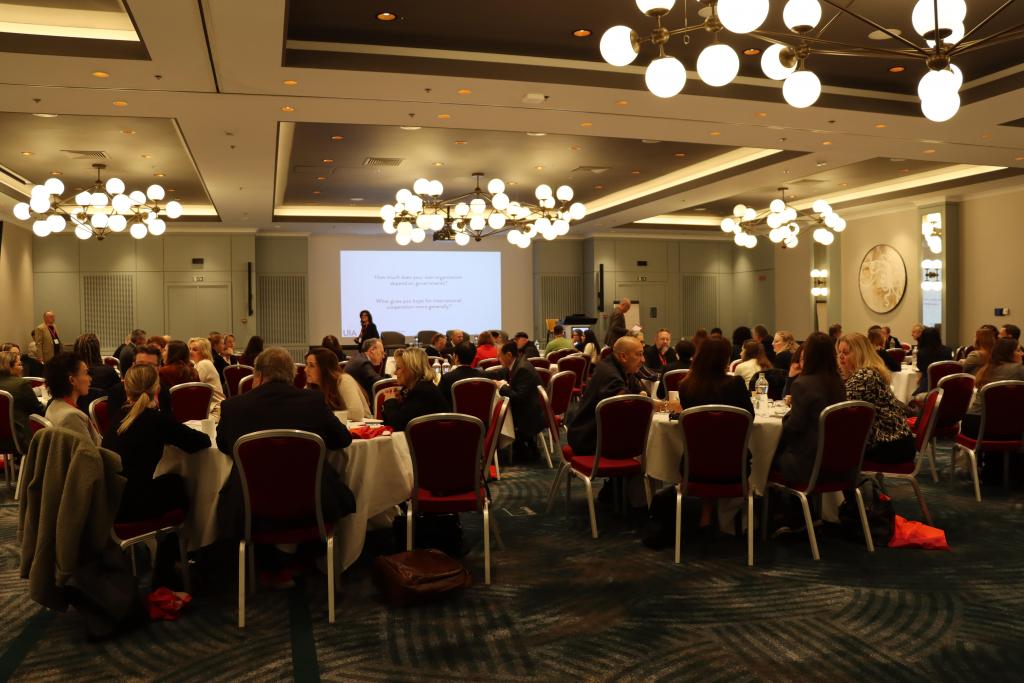
Associations Round Table Europe, held at the Marriott Grand Place in the centre of the Belgian capital. Designed as both a learning forum and a meeting ground, the programme drew a wide range of delegates from global civil society organisations, academic institutions and partner destinations. Brussels remains a key location for this exchange. As the home of many international institutions and associations, the city provides an appropriate setting for discussions on governance, resources, and long-term strategy. Throughout the day, delegates attended plenaries and workshops offering an insight into the operational, political and financial pressures shaping association life, as well as providing practical tools to help organisations navigate these pressures.
Political Context and Institutional Responsibility
The programme opened with a welcome from Jacques de Mévius, Secretary-General of the Union of International Associations (UIA). His introduction set the foundation for the discussions that followed, reaffirming the organisation’s commitment to supporting the international association community through knowledge exchange and peer learning.
His speech was followed by that of Cyril Ritchie, President of the Union of International Associations and First Vice-President of the Conference of Non-Governmental Organisations in Consultative Relationship with the United Nations. In his keynote speech, he examined how associations operate in environments where governmental decisions can influence their stability, relevance and autonomy. The session considered the responsibilities of international associations in an increasingly complex political landscape, encouraging participants to reflect on the intersection of their work with state action and global governance.
Ritchie also chaired a workshop that explored the long-standing relationship between associations and the United Nations. Through historical examples and present-day cases, the discussion highlighted the varied roles that civil society organisations have played in multilateral settings. Participants reflected on the opportunities and limitations of this relationship, as well as the expectations placed on associations when engaging with international institutions.
Legal, Fiscal and Financial Pressures

The regulatory and financial conditions that shape how associations function, contract and plan their activities were addressed in several workshops. Marijke Roelants, Managing Partner of BoldLAW, examined Belgium’s updated liability framework, which has been in force since the start of 2025, in detail. She clarified the distinctions between employees, volunteers, self-employed contributors, subcontractors and directors, outlining how liability may arise for each role. The workshop emphasised the importance of revising internal agreements and insurance arrangements to ensure that individuals acting on behalf of an organisation are appropriately protected.
Philippe Noirhomme of Ryan Tax Consulting analysed VAT and related obligations. He explained how the European Union’s updated regulations impact virtual educational activities, hybrid events, and cross-border services. Many associations are uncertain about this area, and the workshop provided practical guidance to help organisations interpret the regulations in the context of their operations.
Financial sustainability was explored from complementary perspectives. During a participatory session, Joost Visser, CEO of TIAO (Trust Is An Outcome), and Jan Lichota, Coordinator of The Association Place at visit.brussels, led delegates through structured exercises designed to identify shared priorities and examine collaborative responses to changing funding environments and reduced government funding. This approach encouraged participants to suggest actions that organisations of all sizes could take to strengthen their resilience.

The funding landscape was also the focus of a workshop led by Bori Csala, Association Community Manager at Conferli. Drawing on recent research into destination subventions, she examined how financial support can align with sustainability, community engagement and legacy objectives. Her analysis reflected how expectations between associations and destinations are shifting, with a growing emphasis on partnership-driven models that extend beyond cost reduction.
Digital Tools for Association Management
Ryan Brubaker, UIA’s Web and Database Developer, presented the Global Civil Society Database and demonstrated how tools such as the Open Yearbook and Open Calendar can support outreach, event planning and partnership development. His session highlighted the operational value of UIA’s long-running data collection and its relevance for associations seeking partners, visibility or historical reference material.
Historical Perspectives and Organisational Dynamics
A distinctive feature of the Round Table was the contribution of academic experts examining the historical and structural foundations of international cooperation. Prof Jessica Reinisch of Birkbeck, University of London, together with Dr Ria Kapoor of Queen Mary University of London and Dr Margot Tudor of City St George’s, University of London, led sessions exploring the diverse histories of internationalism. Their examples illustrated how global cooperation has evolved through competing visions and power relations. This perspective provided a valuable framework for participants seeking to understand current organisational challenges within a broader institutional trajectory.
Complementing this approach, Prof Daniel Laqua and Dr Gordon Barrett of Northumbria University examined how conflict within organisations can generate creativity when addressed with transparency and intent. Through examples drawn from scientific communities and activist networks, they showed how internal tensions can lead to new approaches rather than organisational paralysis. Their session resonated with delegates managing diverse memberships, governance complexity or multi-country activities.
Together, these contributions linked research-led insight with professional practice, expanding the programme beyond operational concerns. They reinforced the importance of understanding how historical patterns continue to influence the systems in which associations operate today.
A Space for Exchange and Professional Community
The event drew over 100 participants representing healthcare networks, scientific associations, youth organisations, cultural groups, humanitarian initiatives and a wide range of destinations and service providers. This diversity supported cross-sector conversations that revealed common pressures around governance, finance and programme design. It also showed the continued value of platforms that bring together representatives whose work spans different regions and subject areas.
The day concluded with a reception sponsored by the Switzerland Convention Bureau and the Lucerne Convention Bureau. The informal setting allowed delegates to continue discussions initiated during the workshops and reinforced the sense of community that defines the Round Table.
The 2025 UIA Associations Round Table Europe provided a detailed view of the circumstances in which associations operate today. By addressing political uncertainty, regulatory change, funding pressures and the legacies of international cooperation, the programme equipped participants with knowledge and perspective to reassess their own organisational choices. The breadth of expertise featured throughout the day confirmed the importance of dedicated environments where professionals can reflect on the challenges and responsibilities of association work in a shifting global context.
Next Edition
The 20th UIA Associations Round Table Europe will take place in Lucerne, Switzerland, in November 2026. Dates will be confirmed in the coming months. Readers wishing to follow developments are encouraged to monitor updates from the Union of International Associations.
Powered by Meeting Media Company, publisher of Headquarters Magazine (HQ) – a leading international publication based in Brussels, serving the global MICE industry and association community.