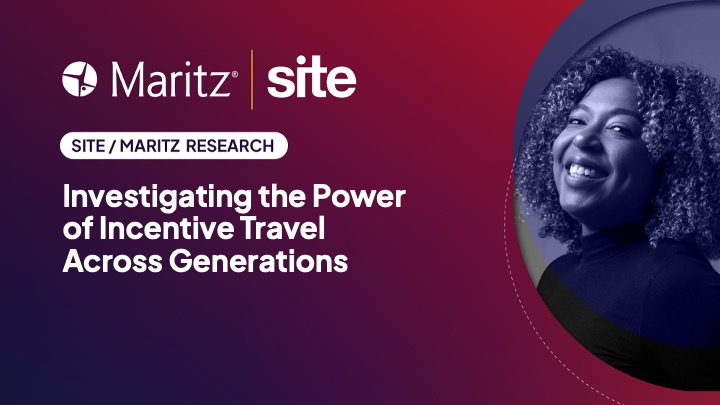
SITE and Maritz have released the headline findings of Investigating the Power of Incentive Travel Across Generations, a major joint research project examining how different generations respond to incentive travel, reward and recognition.
The study — one of the most comprehensive and up-to-date analyses in the sector — explores the attitudes and behaviours of Boomers, Gen X, Millennials and Gen Z, revealing not only the enduring power of incentive travel, but also significant shifts in who is earning these rewards and what they expect from them.
According to the research, travel continues to outperform every other non-cash reward category across all generations. When asked to evaluate nine different reward types, individual travel ranked highest overall, with 61% of respondents describing it as “extremely motivating”. Group travel followed at 50%, outperforming cash rewards, gift cards, points systems and both private and public recognition schemes.
“This research confirms that travel is not under threat from cash. If anything, it is the other way around - cash is under threat from travel. Incentive travel remains the dominant non-cash motivator across every generation,” said Annette Gregg (cover photo), CEO of SITE.
Beyond motivation, the study also reinforces the measurable business impact of incentive travel programmes. Among respondents who had attended an incentive trip in the past three years, 89% said they were more likely to remain with their employer after winning, while the same percentage reported stronger loyalty towards the sponsoring company. Meanwhile, 93% said the experience increased their desire to qualify again in the future.
More than half of respondents — 54% — described the meaning of a group travel experience as “a feeling of achievement”, highlighting the emotional and symbolic value of the reward itself.
 “This data matters because it moves the conversation beyond opinions and gut assumptions. Incentive travel isn’t just a nice reward. It’s a real driver of retention, loyalty and future performance. These findings give program owners a strong business case which reinforces something we see all the time — the emotional side matters. When more than half of people say a group travel experience feels like an achievement, it’s clear the impact goes beyond the trip to create deeper connections within the organization,” said Sarah Kiefer (right), Vice President, Brand at Maritz.
The research also challenges several long-standing assumptions about who participates in incentive travel programmes today. Based on a survey of 1,000 respondents in the United States — with 960 forming the core analytical sample — the findings show that today’s qualifier profile is broader, younger and more operationally focused than the industry stereotype traditionally associated with sales-driven incentive travel.
According to the report, 60% of qualifiers now work in operations or technology roles, while fewer than 10% are employed in sales. Around 80% earn less than USD 150,000 annually, roughly three-quarters have been with their employer for less than a decade and fewer than 10% work remotely.
The study also pushes back against simplified narratives surrounding Gen Z and incentive travel engagement. In fact, 40% of Gen Z respondents reported winning four or more incentive trips over the past three years, compared with 26% among Gen X and Boomer respondents.
However, the findings suggest that Gen Z’s expectations differ significantly. Around 13% of Gen Z respondents said they dislike group travel or travelling with colleagues, compared with 6% of Millennials and 7% of Gen X participants. Gen Z respondents were also less likely to say that winning a trip made them feel valued or more likely to stay with their employer.
The conclusion, according to the study, is not that Gen Z is disengaged from incentive travel — but that programmes aimed at this generation require a different design approach.
In response to these findings, the report outlines five key design imperatives for future incentive travel programmes. Among the strongest drivers of perceived value and loyalty are guest inclusion and flexibility, while first-time destinations consistently outperform repeat destinations in terms of impact and engagement.
The research also highlights the importance of deliberately integrating recognition moments into the travel experience, particularly for younger generations. Longer trips of five nights or more, beach, island or adventure-focused destinations, moderate group sizes between 11 and 50 participants and all-inclusive formats with activities were all shown to perform strongly.
At the same time, the study argues that programme eligibility criteria should expand beyond traditional sales roles to better reflect a workforce that is increasingly multi-generational, operationally focused and technology-driven.
“The next generation of incentive travel will need to be more intentional, more flexible and more inclusive. Guest choice, first-time destinations, built-in recognition moments and experiences that reflect a broader workforce are not ‘nice to have’ design details. They are the factors that determine whether a trip feels personal, motivating and worth pursuing,” added Sarah Kiefer. “The message from the research is clear: incentive travel works, but the best-performing programs will be those designed around current and future qualifiers, not who the industry designed for in the past.”
Annette Gregg added: “This research gives our industry a more sophisticated and more compelling story to tell. Incentive travel continues to outperform other non-cash rewards across every generation, but the data also shows that programme design has to evolve. The workforce being motivated by travel today is broader, more operationally focused and more multi-generational than many traditional models assume. That creates a major opportunity for buyers, DMCs, agencies, destinations and incentive professionals to build programmes that are more inclusive, more intentional and more effective. Most importantly, it gives the industry the evidence it needs to defend incentive travel in the C-suite, not as a discretionary reward, but as a strategic tool for motivation, loyalty and performance.”
The research was conducted jointly by SITE and Maritz, with support from Hilton and the SITE Foundation.
Jonathan Richards, president of the SITE Foundation, concluded: “SITE Foundation is committed to funding research that advances the incentive travel industry and gives professionals the evidence they need to demonstrate value. This study moves the conversation beyond anecdotes, showing how incentive travel motivates a changing workforce and how programmes can be designed to deliver stronger outcomes for participants, businesses and the wider industry.”
Download the report here
Powered by Meeting Media Company, publisher of Headquarters Magazine (HQ) – a leading international publication based in Brussels, serving the global MICE industry and association community.
Since its founding in 1992, Meeting Media Group, publisher of Headquarters Magazine (HQ), has been a trusted guide and voice for associations and the global MICE (Meetings, Incentives, Conferences, and Exhibitions) industry.