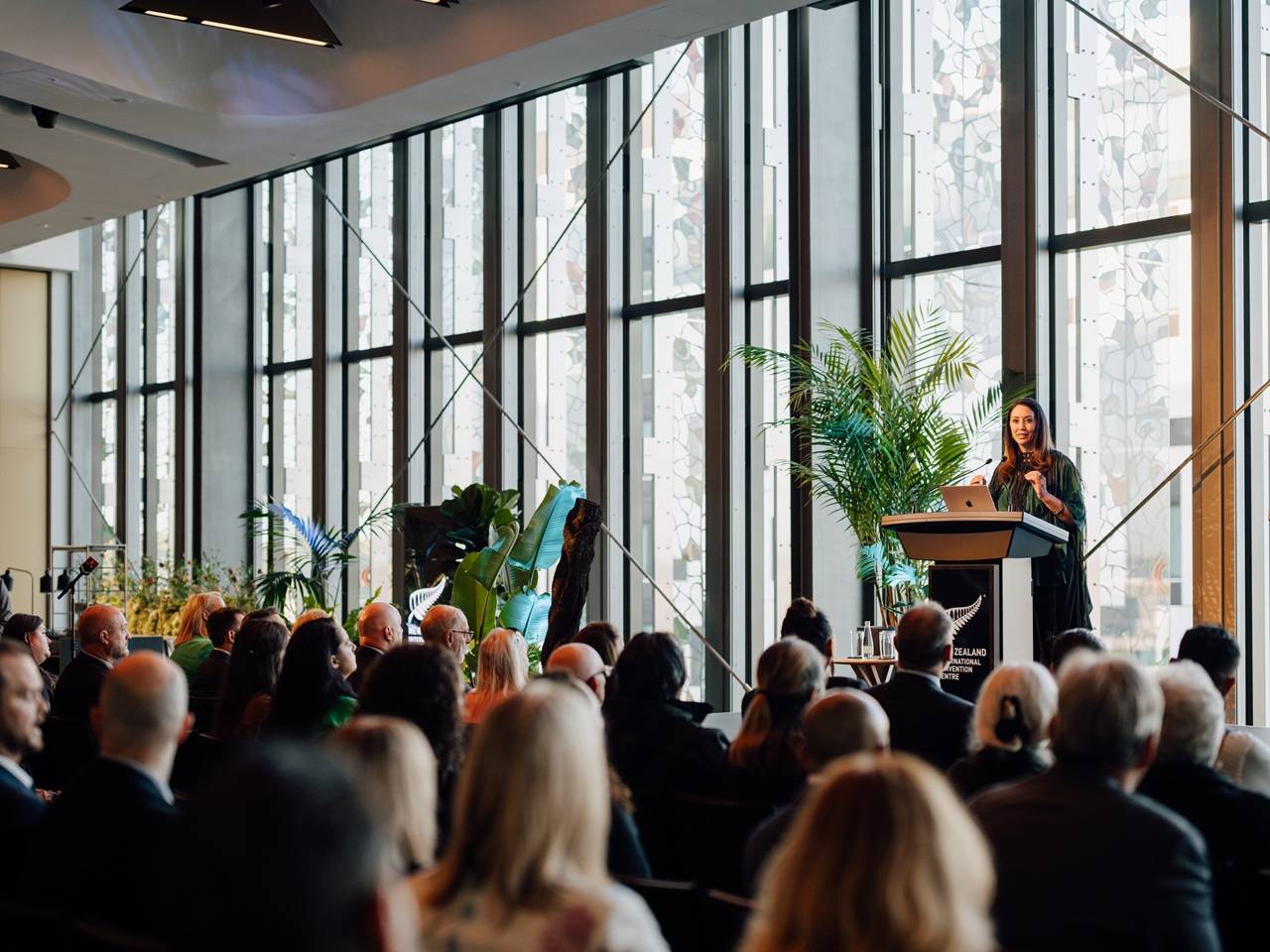
Government and industry leaders used the opening to frame NZICC within New Zealand’s economic strategy for business events, with demand secured and public investment tied to long-term returns. “Tourism is Aotearoa New Zealand’s second largest export industry, and business events are a key part of that growth. Multi-day conferences contributed $925 million (approx. €510 million) in economic productivity in 2025, and with 120 events already confirmed, the NZICC is expected to bring 33,000 additional international visitors,” said Louise Upston, Minister of Tourism and Hospitality at the opening celebration. The figures place NZICC within a segment defined by high-yield delegates and multi-day stays, with a projected annual impact of around NZD 90 million (approx. €50 million) in new visitor spend.
That approach is reinforced in how the venue presents itself to clients. “NZICC is distinctly Aotearoa, with a design that reflects the land and its people, expressed through its art, locally sourced food, and the diversity of the team operating the venue,” said Jason Walbridge, Chief Executive Officer of SkyCity Entertainment Group, the owner and operator of NZICC in partnership with the New Zealand government. The statement frames the venue as a space where design, operations and service express a clear sense of place.
The opening celebration offered an early indication of how this positioning translates into practice. Guests entered through Ariki Hall, passing beneath Helios, a six-metre sun installation by British artist Luke Jerram, establishing the venue’s scale and visual identity from the outset. The programme moved across the building, featuring formal speeches, a kapa haka performance (a traditional Māori art form combining group song, chant and movement), a choral performance by the Auckland Youth Choir, and a live set by Six60, delivering the venue’s first concert. The range of formats demonstrated NZICC’s ability to support live entertainment, cultural programming and formal content within a single event space.

The following day, during an exclusive site inspection, Prue Daly, General Manager of NZICC, highlighted the venue’s cultural identity. “I do not want people to walk in and feel they could be in any convention centre in the world. I want them to feel they are in New Zealand,” she said.
The venue works in partnership with Ngāti Whātua Ōrākei, whose involvement extends beyond the opening ceremony. They sit on the advisory group and have shaped how the building is presented to clients, including gifting the name Te Tumu, meaning ‘the foundation’. For organisers, this provides structured support when incorporating Māori elements into programmes, from language and protocol to storytelling and welcome.
.jpg)
Daly described this as a practical need. Many organisers want to include cultural elements but lack clarity on how to do so appropriately. NZICC positions itself as an intermediary, guiding these decisions while maintaining alignment with local expectations. Cultural integration becomes part of event delivery, not an optional addition.
This could be applied to events of any size. However, Daly framed the venue in terms of usability and flexibility and not just scale. “Ariki Hall can accommodate around 400 exhibition booths or seat more than 3,000 people for dinner, but it can also be divided into smaller, more usable spaces. That allows us to host multiple events at once while maintaining flow through front-of-house and back-of-house areas,” she said.
Ariki Hall spans 6,708 square metres and can support large exhibitions or plenary sessions, while the 33 meeting and breakout rooms enable different event formats to run concurrently.
Flexibility and New Zealand’s identity are also reflected in the venue’s food philosophy. The venue recruited Executive Chef Rob Cullen from a restaurant background to raise the baseline for large-scale catering. “We did not want someone who would simply take conventional conference food and try to elevate it. We wanted a chef with more of a restaurant background, and then we would work out how to deliver that quality at scale,” Daly said. The result is an approach where local produce and New Zealand wine are integrated into the standard offer.
Food waste and sustainability are addressed through operational decisions. NZICC has achieved Qualmark Gold certification and is working towards additional benchmarks, including EarthCheck and Green Star. Daly identified procurement and daily practices as the main drivers, from eliminating single-use plastics to selecting compostable materials and working with local suppliers that support employment within their communities.
From its opening phase, NZICC engaged directly with the international meetings ecosystem. The venue hosted the AIPC Emerging Leaders Academy, the first time the event has been held in New Zealand, within its first week of operations, and welcomed IAPCO EDGE Auckland, focused on education and leadership. It also brought together Business Events Industry Aotearoa (BEIA) and will host MEETINGS 2026 in June, the country’s flagship trade show for business events. These events position NZICC within the global network of convention centres and association planners at an early stage, allowing the venue to be assessed by industry peers while building demand. Daly emphasised the value of peer feedback. “There is real benefit in having peers come through the venue and give feedback at an early stage. If you want to be the best, you have to be open to that,” she said. “People return to the places where they have had the best experience. That is the standard we are setting for ourselves.”
NZICC enables multi-stream conferences, exhibitions and performances within a single integrated venue, supported by a walkable central city environment. It defines a hosting model linking event delivery with economic impact, cultural identity and long-term sector development. The venue also strengthens the national convention network, enabling larger congresses in Auckland while connecting to programmes and experiences across other regions. This encourages longer stays and broader engagement with Aotearoa New Zealand.