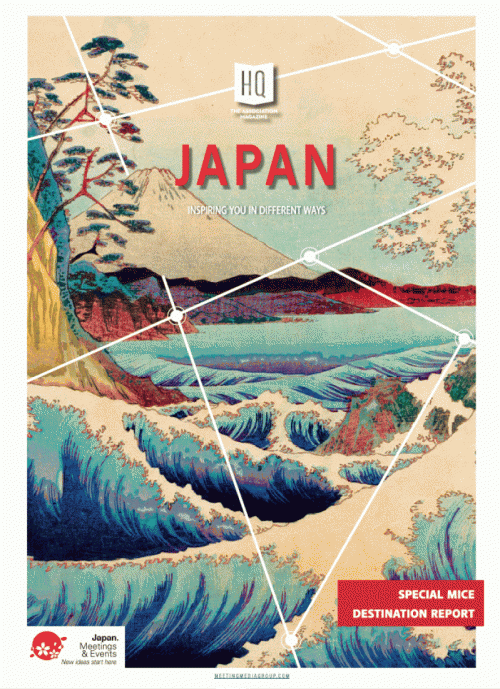
For event organisers, Japan remains a safe, upmarket and flexible country where delegates can experience a unique culture and be inspired by cuttingedge research and design. Plus, many associations benefit from multiple partnerships with Japan’s century-old institutes and companies, advanced technology and modern infrastructure between research centres, factories and unique venues.
During IMEX Frankfurt 2025, our Manuel Fernandes sat down with Koji Takahashi, Executive Senior Vice President of the Japan National Tourism Organisation (JNTO), to review the country’s events profile.
I believe that the MICE industry is extremely important for our inbound tourism. Business events, in particular, have a significant impact as they attract visitors from vast parts of the world, extend their stay, and leave a lasting legacy in the host city. This impact is especially felt in cities outside major metropolitan areas, and the connections made at association meetings continue to stimulate R&D and create new opportunities for the event industry.
MICE activities are an important way of boosting local economies and raising awareness of regional identity and value. One of our strategic activities is the MICE Ambassadors’ programme, which has been running for over 10 years. MICE Ambassadors are influential figures from academia and business who promote Japan in major international conferences. A strong and highly differentiated local identity is a key element in our long-term strategy.
There are many projects underway, but two that stand out are Takanawa Gateway City in Tokyo and Gran Green Osaka, in Osaka. Both will be perfect centres for MICE events, as their conference and meeting facilities are being built alongside hotels, shops, green spaces, and are directly connected to transport hubs. Takanawa Gateway City is already accepting bookings from July this year and has one of the largest multi-purpose halls in Tokyo. Many of our existing conference centres are also continuing to modernise their facilities, with a strong capacity for hybrid events in all sectors.
Although most people think first of cities like Tokyo, Osaka and Kyoto, we want to raise awareness of the plethora of other interesting places to visit in Japan. Thanks to our advanced transport infrastructure, it is very easy to access regional cities all over the country. Each region has its own unique culture, geography and history, which makes them very attractive places to visit. To help support meeting organisers, the Japanese government has designated 12 cities in Japan as global MICE cities, each with its own convention bureau, infrastructure and appeal. Many of the cities outside the Big Three also offer competitive support options to attract events. For example, the International Astronomical Union selected the city of Koriyama in Fukushima Prefecture to host its Asia-Pacific Regional Meeting in 2023, as it wanted to support the region and encourage visitation.

The concentration of academic and industrial assets in each city is extremely important for us. For example, Hokkaido, Japan’s northernmost island, is rich in nature and cluster industries related to tourism and agriculture, which contributed to the successful bid for the Adventure Travel World Summit in Sapporo. In this case, the focus on the city’s industry strengths led to the creation of a legacy in the form of guides and companies involved in adventure travel.
Similarly, other cities have attracted conferences aligned with their academic backgrounds, such as the 17th World Conference on Earthquake Engineering in Sendai, or the Society for the Preservation of Natural History Collections & Biodiversity Information Standards 2024 joint conference, in Okinawa. The success of these conferences is closely linked to these cities, leaving a lasting legacy. The JNTO has also compiled information on 16 of the country’s cities in an electronic brochure called Japan: Competitiveness in Academia and Industry.
Monitoring visitor data to understand trends and develop strategies is extremely important for us as well as for local governments, DMOs, hotels and other tourism-related businesses. We work to aggregate data from sources across Japan and make it available on our Japan Tourism Statistics page. The tools available allow users to easily view the data in their browsers or download statistical data to carry out their own modelling. This data includes comprehensive statistics relating to international conferences, helping the MICE sector in Japan to continue to develop and identify new opportunities.
When we interviewed overseas event organisers, they highlighted our green and efficient transport network, a safe and secure society, the preservation of traditional culture, proactive innovation as a technology-based nation, and the active involvement of local and central governments in achieving the SDGs. JNTO has created a new initiative called Sustainable Japan, an electronic brochure that summarises the strengths and main initiatives in 15 cities across the country.
Each city is carrying out various activities, including environmental considerations, preserving local traditional culture and promoting local production and consumption. Some examples of projects that are helping to drive the adoption of clean energy include the Aichi Sky Expo, which generates 100% of its energy internally using solar power, and the Takanawa Gateway City, which plans to achieve a zerocarbon society through the planned generation of wind, solar and geothermal energy. They also want to adopt a fleet of hydrogen-powered lorries for the transport of goods.

When we look at the overall impact from a holistic perspective, we include infrastructure development, protection of our natural environment, new business partnerships and product development, building local knowledge and international networks, facilitating cultural exchange and much more. To this end, our convention bureaux work with local associations and stakeholders to further engage with our residents and vice versa. We run legacy events in different sectors and locations and, by raising awareness of their long-term significance, we continue to promote MICE initiatives in every city in Japan.
This often leads to public lectures to inspire the next generation of researchers, such as at the International Federation of Automatic Control 2023 World Congress, where the organisers hosted the Girls in Control workshop, in which they introduced control engineering to girls aged 10 to 15 with the aim of increasing the number of women who will pursue science degrees in the future.
Published by Meeting Media Company, the publisher of Headquarters Magazine (HQ) – a leading international publication based in Brussels, serving the global MICE industry and association community.
Since its founding in 1992, Meeting Media Group, publisher of Headquarters Magazine (HQ), has been a trusted guide and voice for associations and the global MICE (Meetings, Incentives, Conferences, and Exhibitions) industry.