Geopolitical turbulence in the world of association events is no longer episodic, but structural... and there is no end in sight. Today, associations are considering what the host city signals to members, stakeholders and the general public. They are also focusing more on alternative funding and revenue generation, as well as more flexible event formats, reflecting a sector in transition, more focused on adaptation geared towards survival. As one of the survey respondents says, “We know we need to change how we deliver and fund our work, but every quarter there is a new crisis. We are firefighting, not future-proofing.”
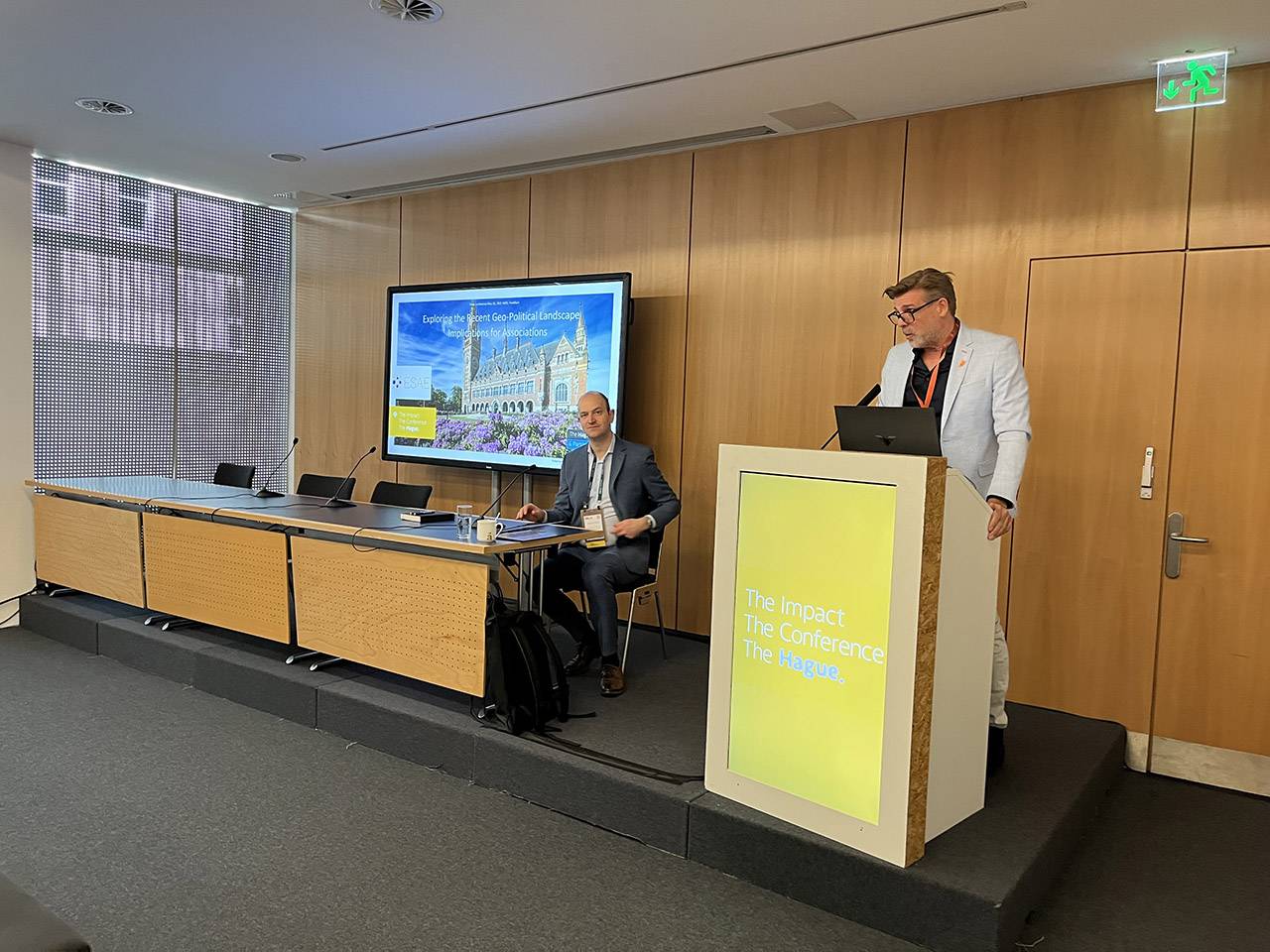
These were the conclusions of the study we analysed with The Hague & Partners in the previous pages and which we continue here with the co-producers, the European Society of Association Executives (ESAE). The interlocutor in our conversation below, Ioannis Pallas, ESAE Managing Director, met with our magazine manager Manuel Fernandes to explain why he thinks the association community is reaching the third level in the evolution of meetings and events.
Ioannis Pallas: We are witnessing the third phase in the evolution of association events. During the first phase, associations were often governed like gentlemen’s clubs who decided to get together on the basis of pleasant locations to network and have a great time. The next phase emerged when associations began to face financial difficulties and sought practical reasons to organise events based on accessibility and cost criteria at the destination. That is when the destination market we know today came into being. Over the past 15 years, budget has been the main criterion for associations, and we see this reflected in how destinations and venues approach associations based on square footage and costs per delegate.
Only recently have we begun to see associations become more professionalised and sophisticated. Many of them no longer see their conference as an ad hoc opportunity that comes around every two years. They are aligning their mission and vision with the destination where the event takes place in order to promote these values. Whether it is expanding their advocacy efforts, gaining new members, opening new markets, or connecting with stakeholders they could not connect with before. This is the third phase, and I think that with the current political situation, last year’s elections in the US and those currently taking place in Europe, the issue of values and political alignment is also beginning to influence associations’ decisions.
IP: Let us first acknowledge that even providing words for specific topics is something new for associations. Until very recently, associations were considered to have a single advocacy purpose, and that purpose was to represent the interests of their members. Furthermore, for an association to take a stance on a crisis, there needs to be consensus among all its members, which is difficult and time-consuming to achieve. By the time they get there, the discourse has usually moved on to another topic. Having to take a position on specific and important social issues was not something that happened often. In that sense, this is already progress. The next step will be to actually practice what is preached and take action, from targeting or excluding some members who are harming the rest of the community, to promoting and granting free membership to some other categories that may be undervalued. This is something we see happening very slowly, so we can see a major threat. On the one hand, I am optimistic because I see things changing, but pessimistic because things are not changing fast enough according to the beliefs and desires of some people.
IP: Today, associations need to be prepared for constant change. We saw this at the European Summit of Associations in March 2020, coinciding with the outbreak of COVID-19. This was a landmark event on permanent crises and how associations need to be agile to navigate them. The world is changing at a rapid pace, and associations need that agility to deal with it. This means having employees who can change roles and take on responsibilities according to circumstances; adopting leadership capable of moving activities and strategic focus; adapting to new revenue streams and reducing the association’s exposure, etc. In a way, allowing governance structures to be neither too rigid nor too complex, so as to give the secretariat some leeway to accommodate these potential changes. The human factor is closely linked to governance, since this structure is the brain behind the operation of an association. If governance is not flexible enough, the association becomes too slow to react and ends up failing to fulfil its purpose.
IP: When it comes to risk management, I believe that sharing risks with different stakeholders is a good strategy. Associations need to be more transparent and open to dialogue with the different stakeholders they work with when organising events. Starting with partners and sponsors, but also including exhibitors and suppliers, such as venues, caterers, hotels, etc. They need to be more transparent about their finances, which would help them reach the break-even point and what would be unfeasible for them. This way, everyone can agree on the premises and meet expectations so that, if cancellation is necessary, there are alternatives that do not mean that one party (usually theirs) bears all the risk.
As for members, I believe that associations have a unique opportunity to be the pillars of their community in times of crisis. When people lose faith, especially in institutions, the economy and politicians, associations can be a safe haven for members to open up freely. Associations should be a place where people are not afraid of being condemned for their positions, a place where they can find alliances and also bring different opinions. We live in a world that is becoming very isolationist, with many rigid positions. Countries are becoming more intolerant than before, so associations still have the opportunity to create a sense of community among their members and engage with different stakeholders.

IP: Indeed, associations are quite diverse, but again, they are linked to very specific topics. For example, a member of a Bar Association is there because they want to establish a connection with colleagues and promote their role in the profession and the development of skills. In other words, not everything in an association is linked to social representation. DEI should govern the association’s mission and operations, but we cannot impose compliance on all members. We need to remember that associations have a mission that needs to be fulfilled even when they expand into different markets. Let’s say an American or European association wants to expand into Southeast Asia. DEI is important to help them be a compass for their integration actions, but the objectives are based primarily on the criteria and priorities that the professional association has defined. If they can do so while protecting and promoting their internal values, so much the better; but we must not forget that it is impossible to have compliance in everything we do. I would say that at this point, it is more of a North Star than a cornerstone.
IP: Because we have not yet reached the level where the online experience matches the experience of in-person participation. Most of all, we have not yet managed to bring these two groups together. No matter how hard we try, it is impossible to replicate the networking and serendipity of in-person events and reconcile this with remote access. We have seen different hybrid formats: events where we only have in-person delegates and online speakers; in-person participants and speakers, but only with the possibility of asking questions online; a total fusion of the two, etc. There are very awkward situations when trying to apply the hybrid format, which is why many people are still afraid of it.
The other aspect is cost. Whenever you apply the hybrid model to your event, the cost is almost double. Associations are still sceptical and seeking a balance between bringing people together in person and reducing their travel burden. I think it is a work in progress, but there is no one-size-fits-all formula for all association events. Some small or regional events may be more beneficial if they take place in person, while other more practical sessions are easily conducted as webinars. As I said earlier, the main reason for an association’s existence is to create a community of individuals who seek consensus. That is why these communities cannot simply be replicated online. The face-to-face aspects of relationship building cannot be overlooked, not least because they are as important as the meeting itself.
IP: No, I believe that tech savviness goes hand in hand with business expertise. As associations become more professionalised, they will have more opportunities to convince their members that they need to diversify their sources of income and services and become more resilient. Otherwise, the only solution is for the members themselves to pay more. They already have a ceiling on how much they pay, and even that ceiling needs to be negotiated repeatedly. Therefore, for associations to achieve their purpose, be agile and less dependent on membership fees, they need to become more experienced in business and technology. This will give them more opportunities to expand their services and, ultimately, better serve their members. Furthermore, remember that after all this talk about associations being in danger or increasingly dependent, most of them have not closed down in the last five years. On the contrary, I see many new associations springing up every year and existing associations expanding their teams and activities. I would not be so pessimistic about the future of associations in a permacrisis mode.
Powered by Meeting Media Company, publisher of Headquarters Magazine (HQ) – a leading international publication based in Brussels, serving the global MICE industry and association community.
Since its founding in 1992, Meeting Media Group, publisher of Headquarters Magazine (HQ), has been a trusted guide and voice for associations and the global MICE (Meetings, Incentives, Conferences, and Exhibitions) industry.