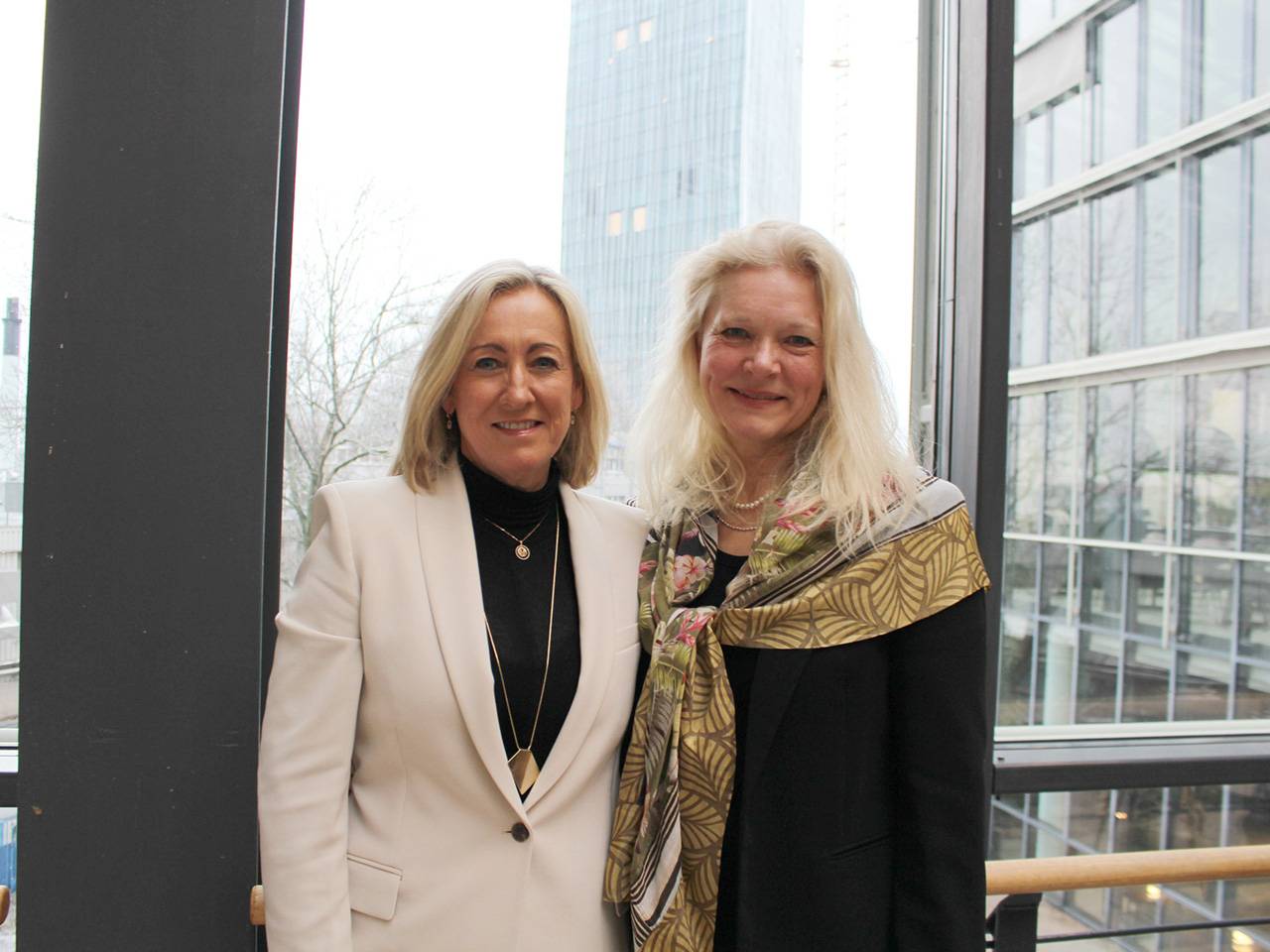
Nicky McGrane, INCON Chair, and Heike Mahmoud, Estrel COO, during the partnership signing © Estrel Berlin
At a moment of decisive growth for one of Europe’s most influential event venues, Estrel Berlin is redefining what a world-class convention ecosystem can be. Already Europe’s largest integrated hotel, congress and entertainment complex, Estrel is now undergoing a transformative expansion with the development of the Estrel Tower — a 176-metre architectural landmark set to become Berlin’s first skyscraper, adding extensive new event space, over 1,100 guestrooms and the capacity to host up to 15,000 delegates under one roof.
In tandem with this physical evolution, Estrel has announced a three-year strategic partnership with INCON — the International Conference Partnership, a globally connected network of leading professional conference organisers, destination specialists and sector suppliers operating across 81 offices in 40 countries. Drawing on INCON’s reach, insight and industry leadership, the collaboration aims to elevate Estrel’s international positioning, expand opportunities for global business development and push standards in venue–PCO engagement to new heights.
At the heart of this bold phase is Heike Mahmoud (on the right), Chief Operating Officer of Estrel Berlin, whose unique trajectory — spanning destination strategy at visitBerlin, trade-fair and convention leadership at Hamburg Messe und Congress and now operational leadership within one of Europe’s most dynamic privately run mega-venues — brings an exceptional blend of strategic vision and execution-driven leadership. In this interview with our Magazine Manager, Manuel Fernandes, Mahmoud reflects on how global partnerships, infrastructure scale, governance balance and future-oriented thinking are reshaping the role of large venues in the international association events landscape.
Indeed, the partnership between INCON and Estrel Berlin comes at a pivotal moment in our strategic development. With the construction of the Estrel Tower, we are making a clear statement about growth, internationalisation, and long-term future readiness — both in terms of infrastructure and market positioning.
This collaboration strengthens our international standing within the association and corporate markets on several levels. First, INCON’s global network provides us with direct access to key decision-makers and opinion leaders across the international business events industry. Second, we benefit from the strategic expertise and market intelligence of INCON’s partners, gaining valuable insights that support the continuous refinement of our services and positioning.
For a venue such as Estrel Berlin, integration into INCON’s global network adds a strategic dimension rather than duplicating existing strengths.
INCON’s structure — bringing together independent, highly specialised partners across key global markets — creates precisely this added value. It connects us directly to local expertise, established client relationships, and cultural know-how in source markets that are essential for successful bidding and long-term positioning. This global reach significantly enhances our ability to anticipate trends, respond to specific client requirements, and engage in meaningful dialogue with decision-makers at an early stage.
Through INCON’s network of specialised PCOs and market experts, we gain early insight into upcoming bids, local association structures, and decision-making processes. This opens doors to markets that may otherwise be difficult to penetrate and allows us to position Berlin — and Estrel in particular — at a much earlier and more strategic stage of the bidding cycle.
For organisers, this collaboration reinforces our advisory capacity. It combines our proven operational expertise as a large-scale convention venue with INCON’s in-depth local knowledge and sector-specific insight. The result is a stronger, more informed bid strategy and a value proposition that extends beyond infrastructure — offering associations a partner with both global reach and on-the-ground expertise.

Exterior of Estrel
In a rotating international congress model, continuity and trust are becoming just as important as destination appeal. With the expansion through the Estrel Tower, Estrel Berlin will be able to offer 40,000 sqm of event space and 1,700 rooms in one place. Through our integration into the INCON network, we see the role of a large venue like Estrel Berlin evolving from infrastructure provider to long-term strategic partner.
Through global network alignment and shared standards of expertise, we can offer associations greater consistency across destinations, reduce operational risk, and provide support well beyond the event days themselves. From early bid development and stakeholder engagement to on-site delivery and post-event legacy planning with INCON members, the venue becomes an active contributor throughout the entire event lifecycle. This partnership strengthens our ability to act not only as a host location, but as an integrated, connected partner.
For a large independent venue such as Estrel Berlin, local identity is not a limitation — it is a strategic asset. Joining a global network like INCON does not mean relinquishing autonomy; rather, it requires a clear framework in which shared standards enhance quality and transparency, while local culture and entrepreneurial decision-making remain intact.
Governance for scale should focus on areas where alignment creates tangible value: professional standards, bid strategy, market intelligence, and international best practices. This ensures reliability and consistency for associations operating across multiple regions. Cultural relevance, local networks, and authentic storytelling are what differentiate a venue in a competitive global market. Preserving this autonomy safeguards brand integrity and allows the venue to respond dynamically to regional expectations.
From left to right: Nicky McGrane, Inge Hanser, Heike Mahmoud, Angela Guillemet, Jan Frederik Vanhamel, © Estrel Berlin
Large integrated venues undoubtedly expand what is strategically possible for associations. When infrastructure, accommodation, technology, and logistics are seamlessly connected — particularly with developments such as the Estrel Tower — organisers can design more ambitious, scalable, and future-oriented event formats.
However, this does not necessarily mean a centralisation of congress activity in only a few locations. While integrated venues may influence decision-making by reducing complexity and risk, associations continue to value rotation for reasons of inclusivity, member engagement, and global representation. We also see a qualitative shift: destinations will increasingly be selected based on their ability to deliver strategic value, sustainability, and long-term impact.
In today’s more volatile economic environment, venues can no longer position themselves solely as space providers. Large integrated platforms such as Estrel Berlin have the capacity to contribute directly to an event’s financial resilience by offering scalable infrastructure, transparent cost structures, bundled services, and hybrid-ready technology that reduces fragmentation and external supplier risk.
While ultimate financial responsibility remains with the organiser, there is a strong case for venues to share greater accountability in the economic success of an event. This does not necessarily imply financial risk-sharing in every instance, but it does require a more partnership-driven mindset: increasing transparency and working collaboratively toward measurable outcomes. In this sense, the venue evolves into a co-architect of economic sustainability rather than merely serving as an operational host.

Estrel Tower Atrium
Transitioning from leadership roles in the public-sector environment to the operational leadership of the privately owned Estrel Berlin required a fundamental shift in perspective.
The most important change was moving from an external, ecosystem-driven view — focused on positioning a city and attracting congresses and events — to an internal, execution-driven responsibility, where strategic decisions translate directly into operational realities. From inside the venue, leadership is not only about advocacy and market development, but also about aligning teams, processes, investments, and customer experience in real time.
In contrast, leading a privately owned mega-venue entails operating within a clearly defined entrepreneurial governance structure. Decisions can be taken more directly, investment strategies are guided by long-term business objectives, and performance is measured with immediate operational and financial accountability. The responsibility is fully concentrated within the organisation — from strategic vision to execution and results. It required learning to think even more commercially, prioritising agility in decision-making, and consistently aligning all internal functions with a unified business strategy, while maintaining the same commitment to quality and international positioning.
Published by Meeting Media Company, the publisher of Headquarters Magazine (HQ) – a leading international publication based in Brussels, serving the global MICE industry and association community.
Since its founding in 1992, Meeting Media Group, publisher of Headquarters Magazine (HQ), has been a trusted guide and voice for associations and the global MICE (Meetings, Incentives, Conferences, and Exhibitions) industry.