.png)
isla is an independent body working to accelerate sustainability across the global events industry through practical strategies, industry guidance, and measurement tools such as TRACE by isla. Founded and led by Anna Abdelnoor (right side), a leading expert in event carbon measurement and data-driven sustainability, the organisation focuses on helping the sector move from ambition to evidence-based action.
In this conversation with our Magazine Manager, Manuel Fernandes (published in may on our HQ #124), Abdelnoor discusses why sustainability still struggles to influence decision-making, the industry’s skills gap and accountability challenges, and why meaningful progress requires better standards, clearer measurement, and a shift from symbolic commitments to systemic change.
In broad terms, associations have increasingly sought destinations and partners that can support them to deliver events with credible, meaningful impact, both for their attendees and for the local destination and community. Sustainability now appears in most RFPs, procurement frameworks and partner conversations far more consistently than it did in the past.
However, the challenge is that sustainability remains a very vague concept. It is often treated as a standalone theme rather than what it actually is: an outcome of a series of procurement, design and decision-making choices that avoid undermining future capability, whether environmental, social or economic. Associations may say sustainability matters, but expectations around what that should tangibly deliver are often unclear or poorly defined.
That is where the sense of moving backwards comes from. Sustainability, as an outcome, is rarely the primary motivating driver when associations select partners or make trade-offs. Cost pressures, talent shortages, political and policy volatility, and broader market instability tend to influence decision-making. Because sustainability is still positioned as a “thing to do” or a workstream, rather than an organising principle, it is easily deprioritised when those pressures intensify.
Ironically, many of the challenges associations are grappling with are symptoms of unsustainable systems. Yet, sustainability is not consistently framed as a strategy for resilience, continuity or risk reduction. Until it is integrated into how organisations think about value, procurement and long-term viability, rather than treated as an adjacent ambition, it will continue to struggle to compete with more immediate pressures.
Yes, I think the sector still lacks clear standards, certifications and regulation to distinguish genuine expertise from opportunism. And no, sustainability is not inherently expensive; it is poorly understood.
Part of the challenge is that sustainability is an umbrella term covering multiple distinct disciplines. It can mean emissions measurement, circularity and product design, supply-chain management, claims and verification, nature impacts, or behavioural change. Each of these requires different skills, methodologies and safeguards, yet they are often collapsed into a single, loosely defined offer.
A useful comparison is finance. Finance is not one thing, but a system of interconnected disciplines – accounting, control, forecasting, commercial strategy, risk management – all governed by standards and professional frameworks that create trust and comparability. Sustainability needs to function in a similar way. At the moment, we are asking to transform an entire system that relies on temporary materials, high-carbon logistics and short-term thinking, without having equivalent structures to ensure consistency, credibility or alignment.
That lack of structure is what makes sustainability feel confusing and costly. In reality, sustainability is not expensive by default. Some choices may involve higher upfront costs, but they often deliver better returns over time through reduced risk, greater resilience and more efficient use of resources. What appears “expensive” is usually cost that has simply been externalised to communities, ecosystems, future operations or future balance sheets.
The scale and diversity of the meetings and events ecosystem does make it harder to create a shared language, comparable measurement and common operating standards. The sector delivers one core service, but it does so across multiple formats, geographies and stakeholder groups, each optimising for different priorities and success metrics. That variation inevitably creates fragmentation in how sustainability is understood and applied.
Across the ecosystem, however, many of the same exposures recur. Destinations, organisers and venues are all affected by a combination of regulatory change, climate impacts, infrastructure stress, rising operating costs, supply-chain constraints, energy and water pressures, insurance availability and long-term reputational risk. These pressures may show up differently depending on the role, but they are not isolated to any single stakeholder.
The opportunity, therefore, is not to force uniformity across a complex system, but to align around those shared exposures. When sustainability is framed through the lens of common risk, rather than individual responsibility or abstract ambition, it becomes much easier to establish shared language and meaningful co-operating standards. Collective action becomes rational, not ideological. That is where real, scalable progress is most likely to come from.
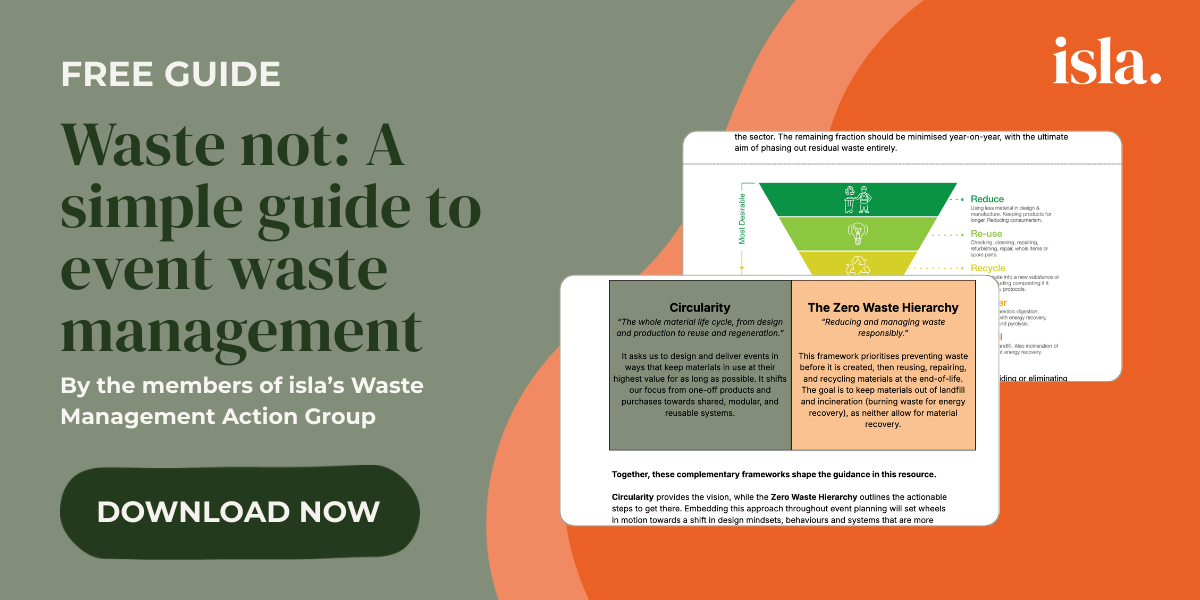
Curated by the isla Members, the Event Waste Management Guide helps event professionals move beyond the take–make–waste approach with clear, practical actions you can apply from the very start of your planning process.
Yes, there is a real skills gap in the sector, and sustainability-literate professionals are still undervalued. Part of the problem is that sustainability has been treated as a separate activity rather than as an outcome tied to long-term business continuity.
This is not primarily about operational substitutions or technical fixes. It is about understanding risk, exposure and resilience over time. That level of thinking sits squarely with boards, directors and C-suite leaders whose role is to protect stability, competitiveness and profitability. Many of the pressures the industry is facing – rising costs, tighter margins, increased competition and reduced demand – are linked to environmental and social risks that are still poorly understood at leadership level.
As a result, sustainability responsibility is often delegated to specialist roles without the organisation having a clear sense of what efficiency looks like. Many businesses have sustainability managers or directors, but senior leadership lacks the literacy to assess the quality or relevance of the work being presented. You would not appoint a finance or commercial lead without understanding the outcomes you expect. With sustainability, organisations often default to vague goals such as “net-zero” without understanding what that actually means in practice for their operations or risk profile.
Until sustainability literacy sits with those who hold accountability for long-term performance, rather than being confined to day-to-day management roles, the industry will continue to struggle to build the depth of expertise it actually needs.
This is an important question, but I think we often look in the wrong place when we talk about willingness to change. The transition is unlikely to fail because individuals are unwilling. It is more likely to stall because we over-focus on delegate behaviour while under-addressing the structural drivers of impact.
Different types of events carry very different responsibilities. At large-scale trade shows with significant temporary builds, a significant footprint comes from materials, logistics and repeated construction and dismantling. We are talking about tonnes of waste and emissions linked to infrastructure that is designed to exist briefly and then disappear. In that context, changes to catering or minor convenience choices are relatively marginal.
That is where the industry’s real challenge sits. Our unique capability is that we can create temporary environments at speed, but circularity cannot mean rebuilding from scratch every time. Until we rethink how stages, stands, flooring and fit-outs are designed, reused and transported in a circular way, we will struggle to make meaningful progress.
Behaviour still matters, particularly where it influences demand for international travel, modal shift to rail, or expectations around scale and frequency. But those behaviours are shaped by public infrastructures and availability. Public transport, energy systems, water security and venue capabilities set the boundaries within which individual choice operates.
Some events therefore need to lead more decisively than others. Organisers with the greatest material and travel footprints are best placed to reshape expectations by redesigning temporary environments, not by asking individuals to make trade-offs in isolation. The perceived value of an event does not need to fall, but it does need to be redefined around quality of experience, relevance and intentionality rather than scale and disposability.
I would argue that the current geopolitical and economic pressures are not separate from sustainability; they are, in many ways, the result of it being poorly understood and consistently deprioritised.
For decades, we have built value by extracting from natural and social systems without accounting for the long-term cost. That debt has not disappeared. It is now showing up as rising energy prices, supply-chain fragility, infrastructure stress, labour shortages and increased volatility. As those costs rise, budgets tighten and sustainability is mistakenly framed as a discretionary extra, when in reality it addresses the root causes of the instability organisations are experiencing.
The risk is not that sustainability lacks relevance, but that it continues to be positioned as an optional investment rather than a stabilising one. The only credible way to drive long-term costs down and restore resilience is to invest in solutions that shorten supply chains, reduce exposure, improve resource efficiency and shift away from linear, "make-use-discard" models.
In that context, appetite and political will will depend on how sustainability is framed. If it remains a sideline initiative, it will struggle to be financed. If it is understood as essential to operational security, economic resilience and long-term competitiveness, then investment is not only justified, it becomes unavoidable.
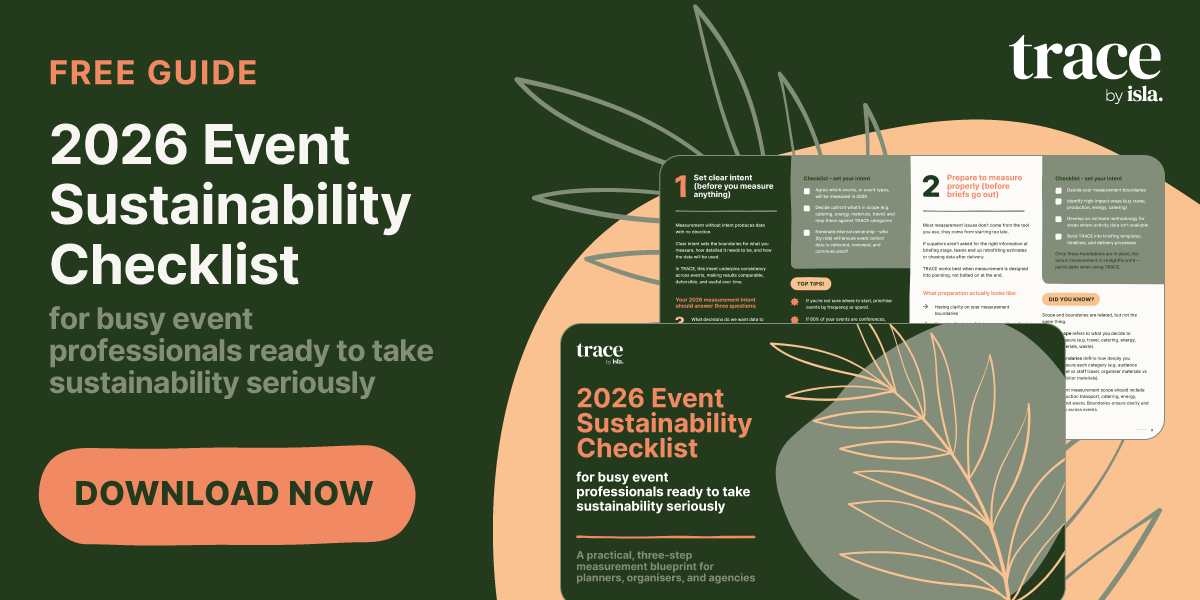
This isla checklist is a practical, three-step measurement blueprint for planners, organisers and agencies who are ready to take event sustainability seriously.
There are several competing issues wrapped up in this question, but the starting point is accountability. Organisers do have influence over travel emissions, even if they do not control aviation directly. Destination choice, event scale, portfolio structure, frequency… these all materially affect how people travel. Choosing locations with strong rail connectivity, breaking large international events into regional formats, or rethinking how often people need to travel are all legitimate levers.
The problem arises when travel emissions are treated as out of scope. The moment responsibility is narrowly defined as “what happens once people arrive”, the incentive to look for solutions disappears. Acknowledging an issue does not mean an organiser or destination is solely responsible for solving it, but ignoring it guarantees no progress at all.
It is unrealistic to expect individual organisations to decarbonise aviation on their own. However, the business events industry collectively represents a significant and influential customer of global travel infrastructure. That gives it a voice – if it chooses to use it – in pushing for efficiency improvements, alternative fuels, new technologies and better policy alignment. Fragmentation weakens that influence, but it does not remove the responsibility to engage.
Meaningful mitigation, in this context, starts with transparency and honest measurement. It then extends to demand management, portfolio design and collective pressure rather than symbolic gestures. Alongside waste and emissions from temporary event infrastructure, travel is one of the two areas where the industry has the greatest exposure and the greatest potential impact. Dismissing it because it is difficult is a short-sighted missed opportunity.
This is a nuanced question. I am a strong advocate for in-person connection. I have never seen digital or hybrid formats replicate the depth of trust, creativity and relationship-building that happens when people are physically together. Knowledge transfer can happen online, but human connection and shared experience remain uniquely powerful in person.
That said, digital and hybrid formats can function as allies, but only in specific, intentional ways. At the moment, digital transformation and sustainability often run in parallel rather than converging. Technology is frequently used to extend scale, complexity and output, not to reduce impact. We should also be honest that digital infrastructure, particularly AI-driven tools, carries its own and growing environmental footprint.
There is a risk in assuming technology automatically lowers impact. Historically, efficiency gains tend to increase activity rather than reduce it. When things become easier, faster or cheaper, we do more of them. That same dynamic applies to events, where technology often enables greater reach and frequency rather than fewer, more considered interactions.
Where technology may play a more constructive role is in helping the industry be more intentional. Better data, smarter planning and clearer insight can support decisions about when in-person gatherings genuinely add value, and when they do not. In that sense, digital tools can help reduce unnecessary travel or duplication, rather than replacing physical events entirely.
Interestingly, one possible outcome of technological saturation is a renewed focus on simplicity. As digital experiences become more complex and mediated, the value of well-designed, lower-infrastructure, human-centred gatherings may actually increase. If that shift happens, it could reduce environmental impact not because of technology itself, but because of how it reshapes expectations around what an event needs to be.
Yes, I think the industry absolutely should be asking that question, but not in a way that leads us to conclude that events should stop happening.
Every organiser, venue and portfolio owner should be regularly reviewing relevance, scale and frequency. Stripping out duplication, consolidating where value is thin, and being more intentional about why an event exists is simply good business practice. If organisations are not doing that already, sustainability is not the issue... governance is.
However, questioning why an event happens should not be confused with questioning the value of coming together at all. Human connection is foundational. Being together is how we build trust, community, shared understanding and progress. That cannot be replicated at scale through digital substitutes alone, and I do not think we should be trying to remove it from society.
The real shift is not about fewer connections, but fewer unnecessary ones. Less production, less disposability, less scale for scale’s sake. More considered gatherings that are purposeful, human and proportionate. Sustainability, in that sense, is not about diminishing events, but about restoring meaning to why and how we convene in the first place.
Powered by Meeting Media Company, publisher of Headquarters Magazine (HQ) – a leading international publication based in Brussels, serving the global MICE industry and association community.
Since its founding in 1992, Meeting Media Group, publisher of Headquarters Magazine (HQ), has been a trusted guide and voice for associations and the global MICE (Meetings, Incentives, Conferences, and Exhibitions) industry.