What if the problem is not that business events lack value, but that we have been asking the wrong questions of them? A destination can know precisely how many delegates arrived, how much they spent and how many room nights an event generated, yet still struggle to explain what those events changed... or how they contributed to the place the destination is trying to become. The more closely business events are drawn into conversations about talent, innovation, resilience and competitiveness, the more important that question becomes.
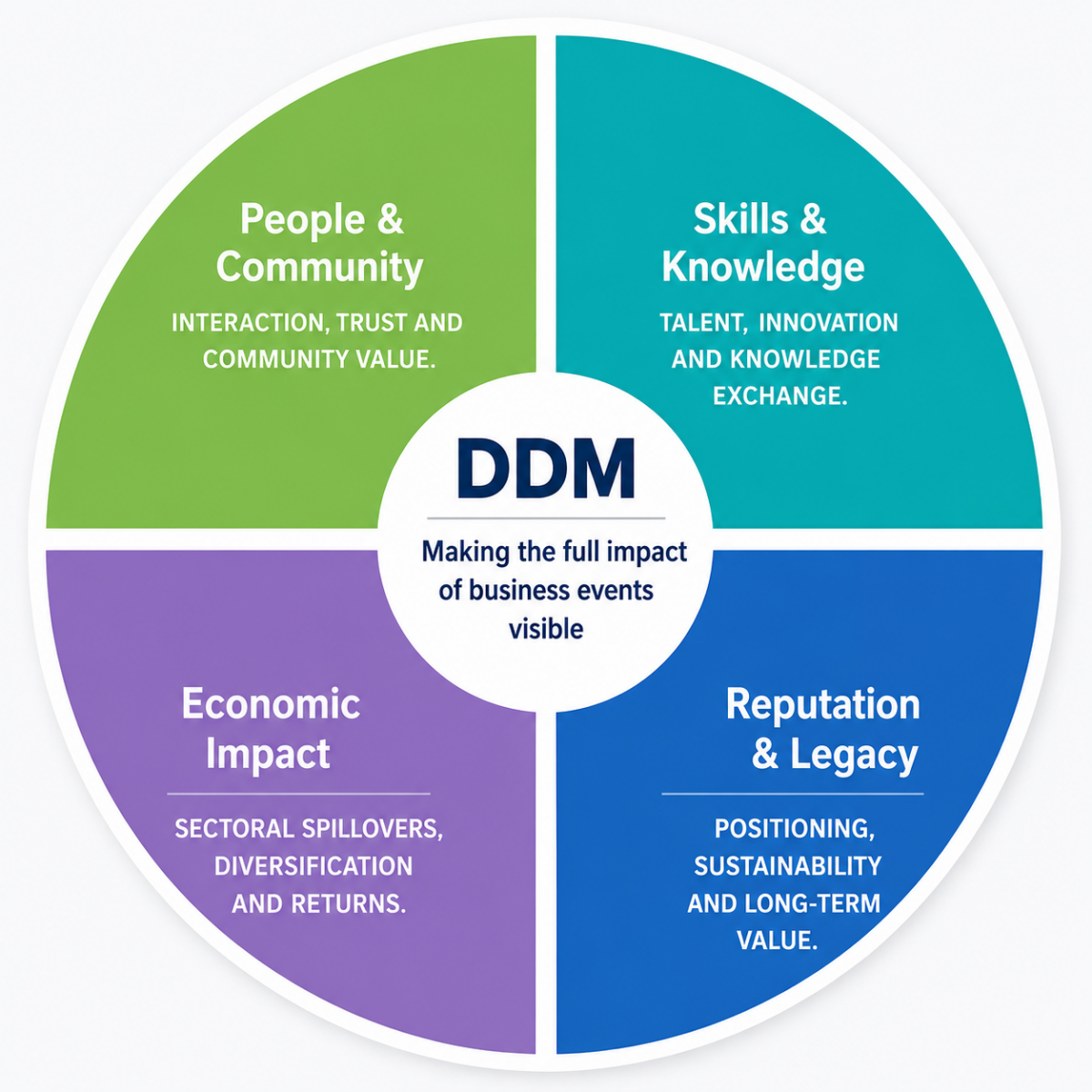
This is the gap that jwc’s new Destination Development Model (DDM) seeks to address. Developed and first tested with the Singapore Tourism Board, the framework connects a destination’s policy ambitions with the contribution of its business events portfolio and the outcomes that matter to public-sector decision-makers. It assesses those contributions across fifteen dimensions grouped into four areas – People & Community, Skills & Knowledge, Economic Impact, and Reputation & Legacy – providing a broader basis for strategic decisions around bidding, investment and portfolio development.
For jwc Managing Partner Kai Hattendorf, the shift is ultimately about changing the conversation between the business events sector and policymakers: from demonstrating activity to demonstrating relevance. In this interview with Headquarters, he explains the thinking behind the DDM, what the Singapore pilot revealed, how the model approaches less tangible forms of legacy and why its application could extend well beyond destinations with advanced data capabilities.
The challenge is that such metrics focus on activity rather than outcomes, and therefore often miss the bigger picture. Delegate numbers, room nights and visitor spend tell you how busy a destination was; they do not tell you whether events are helping it become what it wants to be. Economic impact, when calculated properly, provides valuable insight into outcomes, but only economic ones.
That gap matters because governments do not fund activity; they fund outcomes such as talent, innovation, resilience, sustainability, economic positioning and community value. For decades, the business events industry has been fluent in outputs while largely silent in that “second language”. As public funding tightens and scrutiny increases, “we delivered X room nights” is no longer an answer to the question: “What did this do for the city?”
The Destination Development Model (DDM) is designed to close that gap. It sits above impact studies rather than replacing them, connecting a destination’s policy ambitions to what its event portfolio actually contributes across 15 dimensions, grouped into four clusters: People & Community, Skills & Knowledge, Economic Impact, and Reputation & Legacy.
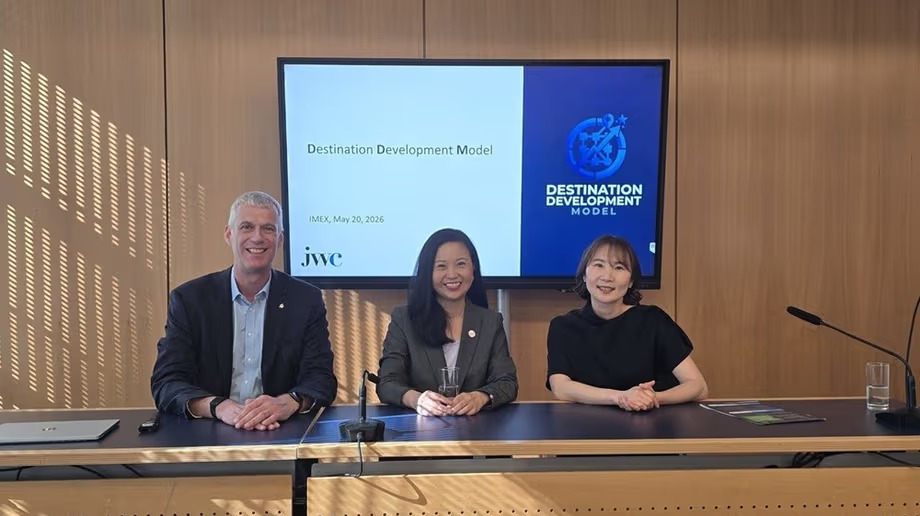
Presentation of the new JWC structure at IMEX Frankfurt 2026, piloted with the Singapore Tourism Board © jwc
They feed into each other. Every project we undertake with the DDM begins with an analysis of the destination’s own priorities. We examine its policy ambitions and score them across all fifteen dimensions of the model. We then assess how the existing business events portfolio, from trade shows to government events, contributes to those goals, identifying where events already deliver and where there is potential to advance the destination’s specific priorities further.
Commercial reality is part of that picture. The formats that drive commercial value, such as exhibitions and corporate events, are often the same ones delivering policy outcomes, whether by bringing talent and capital together or activating multiple economic sectors at once. Alignment means recognising that the commercial engine of the sector is often the same engine delivering the public goal.
In practice, this enables better portfolio decisions. Any bureau can make a more grounded case when deciding which events to bid for, while a destination can make more informed decisions about which infrastructure to fund and grow. The insights provided by the DDM allow policymakers and destination marketers to prioritise projects according to policy priorities and commercial return at the same time, rather than treating the two as separate cases.
Singapore was the right first partner because it offered three things the model needed to be tested against: strong policy alignment, a mature business events market and advanced data availability. We wanted our first pilot to take place in an environment where policy ambitions are explicit and the data available could genuinely stress-test the framework. Working with the Singapore Tourism Board gave us that opportunity.
The pilot also included an academic component with the Singapore Institute of Technology, where students scanned potential data sources for each dimension, providing an early, independent indication that the model is measurable in practice. The findings of the report remain with Singapore, as DDM results are for the respective clients only.
However, I can quote Ong Huey Hong, Assistant Chief Executive of the Singapore Tourism Board, who says: “The DDM pilot offers a structured way to consider how business events can drive meaningful outcomes to the destination beyond the event itself. (…) We want to ensure that growth is underpinned by lasting value for our destination, industries and communities, and the DDM gives us an evidence-based framework to demonstrate that.”
We do not pretend to make the intangible perfectly tangible. Our model gives those outcomes a structured, comparable place in the assessment rather than leaving them as anecdotal evidence. And it will only improve over time.
It works in two layers. Drawing on available industry data, case studies, jwc’s proprietary database and qualitative insights, we have developed a universal impact score. This provides a destination-neutral baseline that scores how different event types create impact across a range of specific dimensions. That baseline is then adapted to the destination using its actual event mix and industry data. As a result, “knowledge exchange” or “community impact” moves from being a broad claim to becoming a dimension with a score, a policy target and a stated delta between the two.
Community legacy is a good example of this logic. Its impact depends on institutionalisation: whether the temporary expertise an event brings to a city is absorbed into permanent local structures once the event ends. The likelihood of this happening depends on event formats, programmes and the profile of those attending. These are tangible parameters that can be assessed, producing a score. Across all fifteen dimensions, the result is a set of scores based on a consistent scale, and that consistency is what allows a destination to act on the findings rather than simply assert them.
The framework is built precisely for that conversation. Its purpose is to express what events deliver in the language policymakers use: priorities, resource allocation and outcomes.
It allows destination marketing organisations, convention bureaux and similar players to rewrite their script as it changes the terms of the argument. Instead of defending a budget for a particular bid, a bureau can show a government where its event portfolio already advances stated policy goals, where the gaps are, and where the next bid, funding decision or portfolio choice could move the needle on the destination’s policy targets. This reframes events from a cost to be defended into an asset, or, more accurately, a toolbox of assets to drive policy objectives. That represents a stronger position when making the case to a finance ministry.
But to be seen in those terms, destinations have to demonstrate the impact and value they bring, using the language and metrics that policymakers value. That is the potential of the model: it is a decision and alignment tool, instead of another lobbying metric.
It also shows, just as clearly, where business events are not the right lever for a particular ambition within a given dimension. That transparency is part of what gives the argument weight when it matters. For each destination, the DDM can therefore trigger a unique set of priorities for the future, moving beyond more conventional approaches.
By all means. The universal base is the same for everyone, which is what makes destinations comparable. What varies is the destination-specific layer, and the depth of the calculation can be scaled with the data a destination can provide. The more detailed the event and industry data, the more granular the analysis; where data is thinner, the model still works, but at a higher level.
That makes it viable for smaller and emerging destinations as well as mature ones. A destination does not need advanced data maturity to get started. It needs clearly defined policy priorities and access to its existing event data.
The first step is deliberately small: a guided self-assessment of policy targets, dimension by dimension, followed by an analysis of the local event mix. From there, the destination gets its own scorecard and identifies its own gaps. At jwc, we are now working with a small founding group of destinations to co-develop the next phase of the model. Reach out if you want to be a part of that!
Published by Meeting Media Company, the publisher of Headquarters Magazine (HQ) – a leading international publication based in Brussels, serving the global MICE industry and association community.

Since its founding in 1992, Meeting Media Group, publisher of Headquarters Magazine (HQ), has been a trusted guide and voice for associations and the global MICE (Meetings, Incentives, Conferences, and Exhibitions) industry.