Destinations International will convene destination leaders, policymakers and industry stakeholders on 16 September for a global virtual programme focused on funding, political engagement, community relationships and the case for destination organisations.
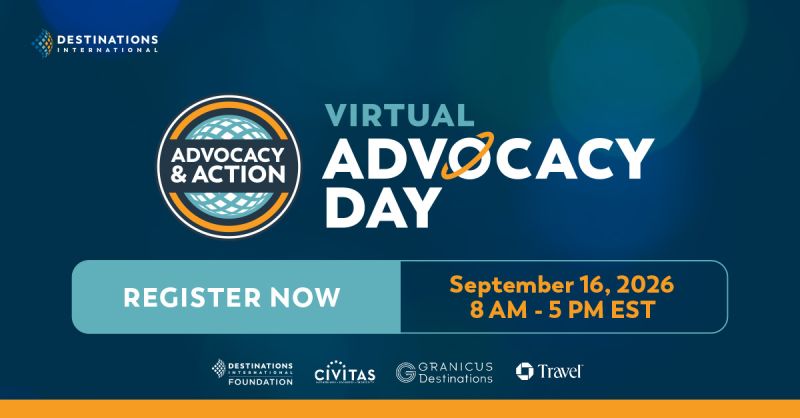
For destination organisations, advocacy is becoming harder to separate from the day-to-day business of destination management. Public funding is under greater scrutiny, political priorities can shift quickly, economic uncertainty continues to test tourism models, and residents and other stakeholders are demanding clearer evidence of how destination organisations contribute to the communities they serve. Against this backdrop, Destinations International (DI) will hold its second Global Virtual Advocacy Day on 16 September 2026.
The one-day programme is designed to help destination leaders, government affairs and communications professionals, industry partners and other stakeholders develop practical approaches to advocacy, with sessions running from 8:00 a.m. to 5:00 p.m. ET.
The central argument from DI is straightforward: destination organisations cannot afford to wait for a funding dispute, political challenge or community backlash before beginning to explain their value.
“Destination leaders today are operating in an environment where funding, public perception and political support can change remarkably quickly,” said Don Welsh, president & CEO of Destinations International. “We cannot wait until a challenge emerges to begin making the case for our work. We need strong relationships, credible data, compelling messages and trusted advocates already in place. Virtual Advocacy Day is about giving destination leaders the knowledge and tools to be ready, confident and effective.”
The programme reflects the breadth of issues now sitting within the advocacy remit of destination organisations. One session, Policy That Performs: Funding Tourism While Protecting Place, will examine tourism levies, taxes and other policies intended to create sustainable funding while balancing economic development with community well-being.
That balance is central to the wider advocacy challenge. Destination organisations have traditionally had to demonstrate their contribution to visitor economies, but the political and social case for tourism increasingly requires them to explain what that activity means for residents, infrastructure and the wider development of a place.
Another session, Building Consensus: How Destination Leaders Turn Relationships into Results, will focus on the relationship-building required to turn stakeholders into advocates. Trust, listening and sustained engagement will be considered not as supporting activities, but as fundamental components of effective destination advocacy.
The programme will also look at how destination organisations can prepare for periods of economic disruption. Weathering the Storm: What 30 Years of Downturns Teach DMOs About Surviving the Next One will draw on previous recessions, funding crises and industry disruptions to consider what destination leaders can do before the next downturn arrives.
Infrastructure and urban development will receive attention through The Missing Partner in Destination Development, which will explore the potential for stronger relationships between destination organisations and city planners.
For an industry increasingly concerned with the relationship between tourism, urban development and community priorities, the question is broader than whether destinations can attract more visitors. It is also whether destination organisations are sufficiently embedded in the conversations that determine how places themselves evolve.
The political dimension of destination advocacy will be addressed directly in The Politics of Destination Funding: Advocacy, Influence & Strategy. The session will examine the distinctions between advocacy, lobbying and electioneering, and how destination organisations can engage appropriately with policymakers.
That distinction matters for organisations operating in environments where public funding, taxation and tourism policy can become politically contested. The ability to make a case for tourism is not necessarily equivalent to political campaigning, and destination organisations need to understand where the boundaries lie when engaging elected officials and other decision-makers.
DI will also take a practical approach with Building Your Destination’s Advocacy First Aid Kit, designed to help organisations establish the relationships, research, evidence, messages and internal responsibilities they need before a challenge emerges. The emphasis is therefore on preparedness rather than reaction.
The event will also see the unveiling of the 2026 Tourism Lexicon and Social Impact Lexicon, research intended to help destination organisations reconsider how they communicate with the audiences whose support they need.
The premise is that familiar tourism terminology does not always resonate with elected officials, residents, board members, business leaders or the media. The new research will examine the words, messages and concepts that can better connect destination activity with the priorities of local communities.
It reflects a wider shift in how destination organisations are being asked to articulate their role. Metrics such as visitor numbers, hotel occupancy and economic impact remain important, but they do not necessarily answer every question posed by residents or policymakers.
The ability to translate tourism's contribution into language connected to broader community priorities may therefore become as important as the data itself.
“Advocacy is ultimately about relevance and trust,” said Andreas Weissenborn, senior vice president, advocacy & destination advancement at Destinations International. “Destination organizations need to understand what matters to their communities and demonstrate how their work contributes to those priorities. This program is designed so participants do not simply leave with ideas. They leave with strategies and tools they can begin using immediately.”
DI is encouraging CEOs and destination leaders to participate alongside government affairs, communications and community engagement teams, while also inviting board members, elected officials, public-sector partners and other community stakeholders.
That emphasis on collective participation is significant. Advocacy is rarely the responsibility of one individual or department. The case made by a destination organisation needs to be understood consistently by its leadership, board, communications team and external partners if it is to carry credibility when public or political scrutiny intensifies.
The virtual format is intended to make that broader participation easier, removing the travel costs and time commitment associated with an in-person programme. It also allows destination organisations to bring internal teams and external stakeholders into the same conversation and establish a common understanding of what effective advocacy should look like.
For DMOs and CVBs, the underlying lesson is increasingly difficult to ignore: the case for destination management cannot simply be made when budgets are threatened or policies are being decided. It has to be built continuously through evidence, relationships and relevance.
Destinations International's second Global Virtual Advocacy Day will put that proposition into practice, bringing together the political, economic and community dimensions of destination advocacy in a programme aimed squarely at preparing organisations for the challenges ahead.
The event forms part of Destinations International's Advocacy & Action initiative and is supported by the Destinations International Foundation, Chase Travel, Civitas and Granicus Destinations.
Find the complete agenda and registration here
Powered by Meeting Media Company, publisher of Headquarters Magazine (HQ) – a leading international publication based in Brussels, serving the global MICE industry and association community.
Since its founding in 1992, Meeting Media Group, publisher of Headquarters Magazine (HQ), has been a trusted guide and voice for associations and the global MICE (Meetings, Incentives, Conferences, and Exhibitions) industry.