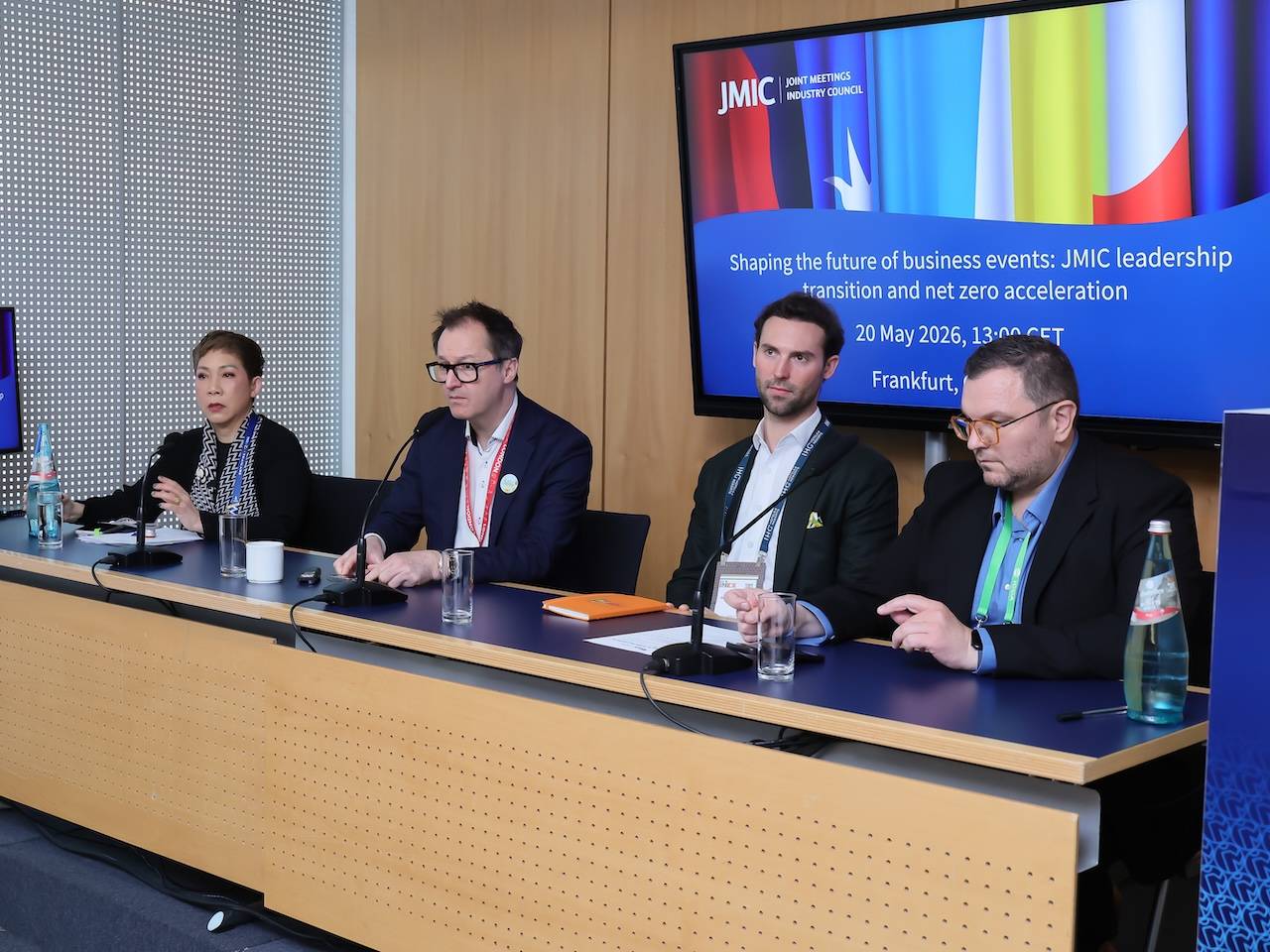
Dr. Supawan Teerarat, President of TCEB; James Rees, president of JMIC; Dorian Kronenwerth, the new executive director of JMIC; and Alexander Alles, former JMIC director, during the press conference at IMEX Frankfurt 2026.
When the Joint Meetings Industry Council (JMIC) unveiled its new leadership at IMEX Frankfurt earlier this year, the announcement marked far more than a change at the top of the organisation. In front of an international audience, and with Headquarters in attendance, the Council presented an ambitious roadmap for the future of the global business events industry, launching its updated Global Manifesto, outlining the next phase of the Net Zero Carbon Events (NZCE) initiative, and reaffirming its commitment to stronger, evidence-based advocacy. Together, these initiatives reflect a broader ambition: to position business events as drivers of innovation, knowledge exchange and long-term societal value, while giving the industry a more coordinated and influential voice.
Following that announcement, HQ sat down with Dorian Kronenwerth, JMIC's new Executive Director, who recently succeeded Alexander Alles in the leading role, to explore the priorities that will shape this next chapter. Taking office at a time when the industry is redefining not only how it measures success, but also how it communicates its value to governments, institutions and society at large, Kronenwerth inherits an organisation with a powerful, influential voice and an ambitious agenda. From advocacy and geopolitical challenges to climate action, talent development, AI and the need to build greater alignment across an increasingly fragmented industry, we discussed how JMIC intends to translate vision into measurable action. And why the future of business events will depend not only on proving their value, but on speaking with one clear and compelling voice.
The renewed version came from watching what actually moves governments versus what we assumed would. Framing business events as engines of growth and innovation got us listened to; abstract papers, on the other hand, rarely got us funded. It is also clear that no single organisation can speak for the whole ecosystem: what is right for the UK or France is not necessarily right for Sydney or Johannesburg. The 3rd Edition, therefore, closes both gaps at once: less a declaration and more an operating toolkit, pairing 15 concrete pathways with real case studies, sourced from the Iceberg, so a regional association can walk into a ministry meeting with something specific and locally relevant, rather than aspirational and generic.
That shift matters because the risks are not abstract. VisitBritain, for example, is scaling back its business events unit, whilst punitive event taxes surfacing in several markets. What the industry needs to communicate differently is stakes and specificity: framing $759 billion in direct spend and $1.8 trillion in total impact against decisions ministries are making right now. One size fits all does not work anymore.
Our ambition is to create a stronger, more aligned voice, not to lecture the industry on what to do. We speak on its behalf, we listen, and we build tools members can actually use around a strong central message, which regional members then tailor to their own destinations. That is what the Manifesto is built to do: flex the global, high-level thinking into local, concrete context that policymakers can understand.
Ultimately what matters is that the industry is heard by decision-makers, because we generate impact, revenue, jobs and legacy. We do not ask members to agree on everything; we ask them to agree on where a single voice is worth more than several accurate ones. But honestly, the sharper question right now is internal: what should JMIC's own voice actually cover, and where should it deliberately stay quiet and let members lead. We are in the middle of a genuine reflection process on exactly that, this year. I would rather let the outcome speak for itself when it lands later this year than characterise it prematurely.
Our mandate is the free movement of knowledge, expertise and people to meetings. That is not a political position, it is the core product we defend. The effect of cross-border business events is enormous: our industry brings together the great minds of the world, in science, politics, economics, and without that, great things simply do not happen. We should not be shy about that; we should be clearly aware of it.
But banging out numbers alone does not work. Our advocacy needs to be believable, with tangible, human elements alongside the economic ones, inspiring, not just quantifying, the impact of business events on destinations and people. What needs to change is not the mandate, it is the method: moving from reactive statements after each disruption to building the evidence base that makes the case for mobility structurally, before it becomes a crisis.
Standards were the hard part five years ago; now it is adoption and proof. Endorsed by the United Nations Framework Convention on Climate Change, NZCE is itself an advocacy platform and proof the industry takes this seriously rather than just talking about it. We are now, with our financial backers, moving toward standardised implementation of the methodologies and tools we have built, with a clear push to get venues decarbonising.
 Two things give me confidence we can deliver on that: Johanna Fuhlendorf (right side) coming on board as dedicated Programme Director means NZCE finally has focused leadership rather than being one of several things on someone's plate; and Greenview's role as technical partner gives us the measurement rigour the initiative needs to move from ambition to something auditable. The NZCE Academy is also a good indicator of this change, with the first live courses running this year, delivered in collaboration with GDS-Movement. Adoption is already visible in practice: across JMIC's membership, meeting planners are increasingly setting sustainability as a key RFP criterion for new business, not a nice-to-have. So, I would say this is becoming a prerequisite and a differentiator both at once. Those who do not embrace the road to net zero will quietly lose clients to those who do.
NZCE is a great example of JMIC taking a leadership position and curating a tangible product that the industry can use. The board is now considering what other areas should be looked at to provide further valuable support. What JMIC has the ability to do is step back. The industry runs 365 days a year, 360°. Everyone is busy all the time. That is where JMIC has the headspace to take a step back, invite commentary, listen and then take the reflection to the next step.
Net zero does not have to mean more expensive. What we have seen at COP conferences is that new technologies often look pricier at first, but as they become the new normal, scale brings the cost down. There is no structural reason for net zero to cost more today. The gap is mostly education. Products and services that do not cost more already exist, the industry just needs to know where to find them, which is exactly the role the NZCE Academy plays: guidance and practical advice on acting on the pledges and roadmaps many signatories have already signed up to.
Beyond that, I think we have relied too much on the moral argument and not enough on the resilience one. Sustainability measures (efficient venues, smarter logistics, local sourcing) are also cost and risk management. They show up in energy bills and supply chain stability, not just in reputation. The organisations doing this well are not out-competing on ethics, they are gaining an edge on efficiency and legacy value to host cities, which is what wins repeat bids and public funding. We need to tell that story in procurement and finance language, not just impact-report language. Numbers, not just narrative. That is exactly where the Manifesto and its case studies earn their keep, with JMIC serving as the conduit for that evidence worldwide.

Dorian Kronenwerth, incoming Director JMIC; Dr Supawan Teerarat, President TCEB; James Rees, President JMIC; Alexander Alles, Executive Director JMIC
AI is very good at giving people the average answer faster. What happens in a room – the tangent, the disagreement, the introduction nobody planned – is precisely what AI optimises away. Being at an event takes you off the hamster wheel and gives you the headspace to think, innovate, learn and connect in a way a feed never will. The amount of AI content, video especially, is only going to grow from here, to the point people will not know if what they are seeing or hearing is real.
So, I do not think AI threatens meetings. If anything, it points to the other way, toward a new peak in physical, in-person engagement. We saw something similar with online conferencing during the Covid-19 pandemic, where they proved genuinely useful and were widely adopted by our industry. However, it is now clear that physical presence is something entirely different. Our job is to make sure events do not mirror AI's homogenisation and stay the place where the serendipity of bumping into someone at the coffee station still happens. In a way to foster the unexpected deliberately, not to assume it happens automatically just because people are in the same room.
The biggest gap is not technical skill, it is visibility. Most graduates never encounter this industry as a career option because it does not have a clean label on a university careers page, or a shared vocabulary to even search for it. People also default to thinking it is mostly about planning events, but it is so much more than that. You can be an architect designing convention centres, a mechanical engineer working out air-conditioning for tens of thousands of people, an airline pilot, a hotelier, a CFO, or a lobbyist. This industry has all of it. We are far more than event managers and travel agents.
This is a fixable problem, and one we are actively working on. It involves some practical, unglamorous resources designed to make the industry easier for outsiders to discover and explore. We will provide more information on this once everything is ready. To a graduate, I would say that few industries put you this close, this early, to how decisions actually get made in science, trade, health policy, while asking you to build something tangible each time.
I would like to see this industry in dialogue with several political houses, not only the culture, sport and tourism side of government, but the economic side too. We are not only tourism, we are a big business with big outcomes. We foster innovation, start-ups, exchange, economic diplomacy, trade and education, and we multiply economic benefit well beyond our own footprint. For JMIC specifically, I would hope we are seen not only as a coordinating body but as a front door, the place you go for credible numbers, shared definitions, common positions and shared data that people actually use, not just cite.
There is a meaningful amount of work landing later this year, so stay tuned. But if I am honest, the conversation we are avoiding is whether this industry needs fewer, better-coordinated organisations rather than more initiatives where everyone is building their own version of the same tool because collaborating is harder than duplicating. That has a direct effect on the credibility of the sector as a whole.
Powered by Meeting Media Company, publisher of Headquarters Magazine (HQ) – a leading international publication based in Brussels, serving the global MICE industry and association community.
Since its founding in 1992, Meeting Media Group, publisher of Headquarters Magazine (HQ), has been a trusted guide and voice for associations and the global MICE (Meetings, Incentives, Conferences, and Exhibitions) industry.