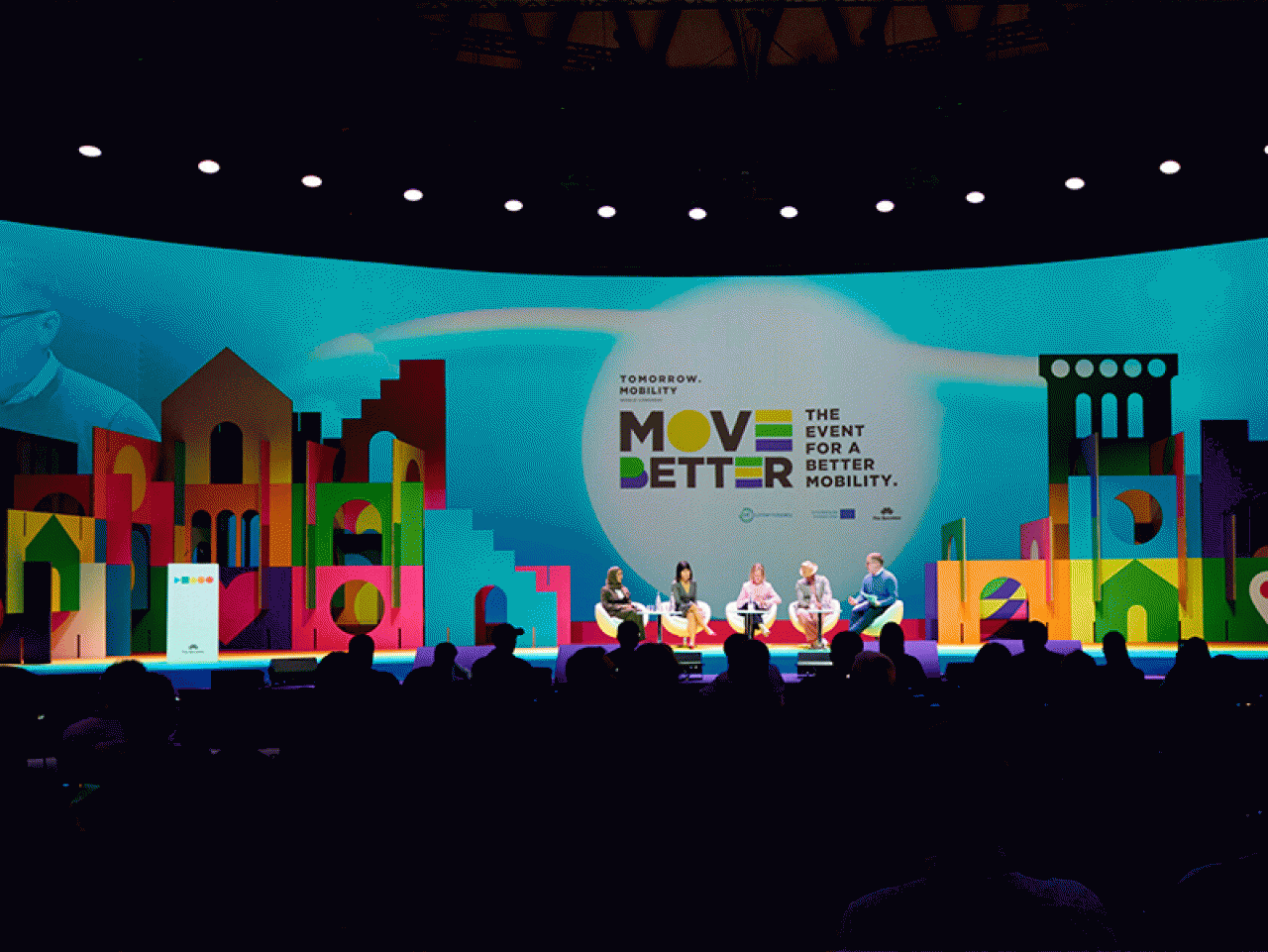
The congress, taking place from 3 to 5 November, will bring together policymakers, city leaders and industry experts to examine sustainable transport, public mobility and the future of urban innovation.
More than 240 international experts from cities, governments and companies will gather in Barcelona from 3 to 5 November for the 2026 edition of Tomorrow.Mobility World Congress (TMWC), where sustainable urban transport and the changing needs of commuters will feature prominently on the agenda.
Held at the Gran Via venue of Fira de Barcelona, the congress is co-organised by Fira de Barcelona and EIT Urban Mobility, an initiative of the European Institute of Innovation and Technology, a body of the European Union. The programme will bring together policymakers, researchers and industry representatives to explore how cities can accelerate the transition towards more sustainable mobility systems.
Among the headline speakers are mobility thinker Lukas Neckermann, Teresa Riesgo, Secretary General for Innovation at Spain’s Ministry of Science, Innovation and Universities, and Axel Volkery, Head of the Innovation and Urban Mobility unit at the European Commission’s Directorate-General for Mobility and Transport (DG MOVE).
Neckermann, who coined the term “The Mobility Revolution” in his first book, works across smart cities, placemaking, shared and autonomous mobility, and urban visions for 2035. He is co-founder of the Urban Places Lab, a Board Member of PAVE Europe, the author of four books and a Visiting Lecturer at Hult, TU Berlin and the University of St. Gallen.
Riesgo, who has held her current position since 2020 and also serves as President of the Centre for Technological Development and Innovation (CDTI), will participate in a high-level roundtable examining how mobility innovators can navigate a period of uncertainty.
Volkery will join a discussion on the evolution of public transport, focusing on how services must respond to changing user habits to remain attractive, accessible and relevant. The session reflects a central challenge for urban transport authorities: adapting established systems to shifting expectations while maintaining the reliability and accessibility on which daily journeys depend.
The speaker line-up also includes Daryl Barron, Lord Mayor of Dublin; Karen Vancluysen, Secretary General of POLIS; Lisandro Perotti, Undersecretary for Mobility Management and Control of the City of Buenos Aires; Toks Omishakin, Secretary of the California State Transportation Agency; KwangSeung Cha, Director General of the AI Innovation Bureau of Seongnam City; Tanja Dik, CEO of the Johan Cruijff Arena; and Tifani Sadek, Professor at the University of Michigan.
The congress comes against a backdrop of persistent challenges around commuting, transport reliability and urban wellbeing. Research conducted by EIT Urban Mobility among 1,503 adults in Barcelona, Munich and Bucharest highlights the central role of public transport in everyday journeys, while pointing to areas where cities could improve the commuter experience.
According to the survey, 56% of respondents use public transport to travel to work or their place of study, ahead of car-based transport, at 52%. Public transport users are also twice as likely to incorporate walking into their journeys.
Safety, reliability and comfort emerged as the factors commuters value most. However, respondents across all three cities identified a gap between their expectations and their daily experiences. Traffic density represents the largest gap for car users, while public transport passengers point to service reliability as a key concern. Overcrowding also affects the quality of journeys.
The consequences extend beyond the transport network itself. More than two in five respondents (41%) reported feeling completely drained when they arrive home after their commute, underlining the relationship between mobility systems and quality of life.
These findings provide a relevant context for the congress discussions, which will examine how cities can exchange knowledge and develop innovative approaches to more sustainable and liveable urban environments. Improving the performance of public transport, responding to users’ expectations and addressing the wider effects of commuting remain important considerations for urban mobility planning.
Tomorrow.Mobility World Congress will take place alongside Smart City Expo World Congress, the international summit dedicated to smart cities and urban solutions, as well as Tomorrow.Blue Economy, the Barcelona Deep Tech Summit and the Barcelona Cybersecurity Congress.
Together, the events are expected to bring more than 1,100 exhibitors and over 27,000 attendees to Fira de Barcelona, creating a shared platform for discussions on urban development, technology and innovation.
Within this wider programme, Tomorrow.Mobility will focus on the transport systems and mobility solutions shaping the future of cities, bringing together perspectives from public authorities, international institutions and the private sector.
Published by Meeting Media Company, the publisher of Headquarters Magazine (HQ) – a leading international publication based in Brussels, serving the global MICE industry and association community.
Since its founding in 1992, Meeting Media Group, publisher of Headquarters Magazine (HQ), has been a trusted guide and voice for associations and the global MICE (Meetings, Incentives, Conferences, and Exhibitions) industry.