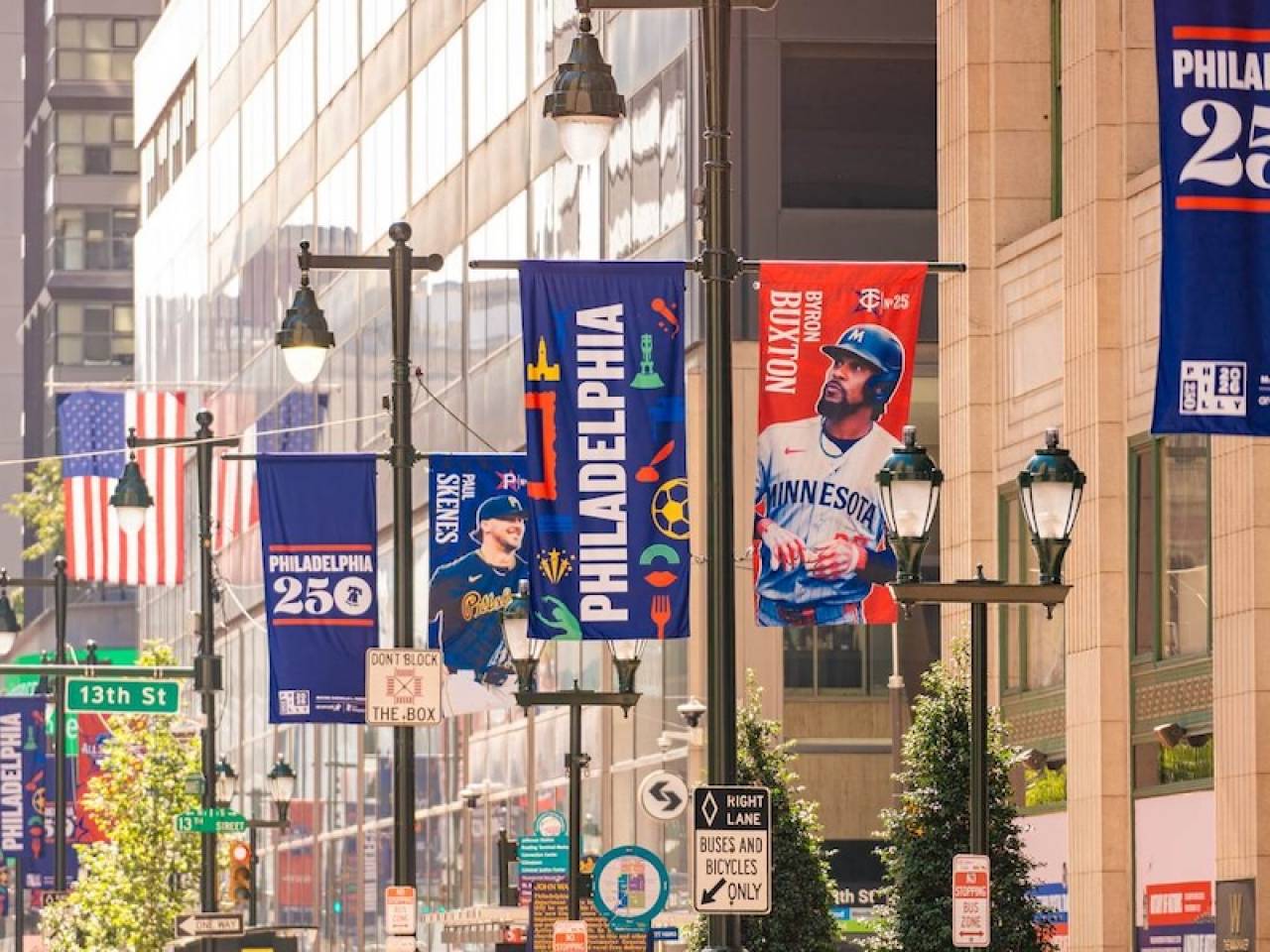
© Philadelphia Convention and Visitors Bureau (PHLCVB)
Philadelphia’s 2026 summer calendar put the city under an unusual level of international attention, combining FIFA World Cup matches, the PGA Championship, MLB All-Star Week and UFC 330 with a wider programme of meetings, conventions and civic celebrations. The effect was visible in the city’s hotel market, where Center City properties recorded $335.6 million in revenue between May and August — 20.6% more than during the same period in 2025.
The figures, released by the Philadelphia Convention and Visitors Bureau (PHLCVB) and sourced from Tourism Economics, offer one of the clearest measures yet of the economic effect of the city’s event strategy during what had been described as Philadelphia’s “Summer of Sports”.
Revenue per available room (RevPAR) reached $188, an increase of 22.2% year-on-year, while average daily rate (ADR) rose 18.9% to $257. Philadelphia’s RevPAR growth was also the strongest among the 25 leading US markets, according to the PHLCVB.
The headline sporting events provided the most visible moments. Philadelphia hosted six FIFA World Cup 26™ matches, including a Round of 16 fixture on 4 July, coinciding with the country’s Semiquincentennial celebrations. The PGA Championship and MLB All-Star Week added further international and national exposure, while UFC 330 contributed another major event to the calendar.
Behind them was a much broader programme. The PHLCVB brought 112 additional meetings and citywide conventions to Philadelphia during the same period, illustrating how major sporting events formed part of a wider business-events strategy rather than operating in isolation.
“This summer gave Philadelphia an unprecedented opportunity to showcase our city to the world, and we proved that we could deliver exceptional experiences on a global scale,” said Gregg Caren, president and CEO of the PHLCVB, whose team lead the charge on bidding and securing NCAA March Madness, MLB All-Star Game, and FIFA World Cup 26™ events, some five to ten years in the making. “Major events also translate directly into business for our hotels, restaurants, and other hospitality partners, supporting the thousands of people whose work makes Philadelphia such a welcoming destination. For the PHLCVB, this summer is more than a moment. It’s a powerful proof point that we can leverage to drive visitation and economic impact for years to come.”
Hotel performance provides a relatively direct way of assessing whether large-scale events are translating into visitor spending and overnight demand. The 20.6% increase in revenue across the four-month period suggests that Philadelphia’s event calendar generated a substantial uplift for the accommodation sector, while the simultaneous rise in both RevPAR and ADR indicates that the result was not simply a consequence of filling more rooms.
The visitor base was also unusually international. According to the PHLCVB, fans attending events in Philadelphia came from all 50 US states and 190 countries. Alongside the World Cup matches, visitors could attend the FIFA Fan Festival™ at Lemon Hill and the America 250 celebrations on 4 July, creating a broader programme around the headline sporting fixtures.
For the hotel sector, the performance provided evidence of the connection between event programming and the wider visitor economy.
“The strength of Philadelphia’s hotel performance illustrates just how valuable major events are to our hospitality industry,” said Ed Grose, president and CEO of the Greater Philadelphia Hotel Association. “Increased revenue provides meaningful support not only for our properties, but for the thousands of people who work in them every day. A strong summer like this creates greater stability for our hotel community while reinforcing the value of continuing to attract events that bring overnight visitors to Philadelphia.”
That question of continuity is now central to Philadelphia’s event strategy. The challenge for a destination after a year of exceptional sporting exposure is not simply to repeat a single blockbuster summer, but to convert the resulting visibility, infrastructure and industry relationships into a sustained pipeline of business.
The city already has another substantial calendar in place. In 2027, Philadelphia will host the NCAA Division I Women’s Basketball Regional Championship and the NCAA Division I, II and III Men’s Lacrosse Championships. The Army-Navy Game will also return to Lincoln Financial Field on 11 December 2027, with the PHLCVB expecting more than 69,000 visitors for the fixture.
The meetings and conventions pipeline is equally significant. The American Institute of Architects Conference on Architecture & Design is expected to attract 13,000 attendees in May 2027, followed by the BIO International Conference in June, projected to bring 16,000. The International Association of Chiefs of Police Annual Conference is expected to draw 20,000 attendees in October, while the AACR Philadelphia Marathon in November anticipates 35,000 participants. All four events are scheduled to take place at the Pennsylvania Convention Center.
The mix points to a strategy that extends beyond sport. Life sciences, architecture, engineering, public health and safety, and professional associations form a substantial part of Philadelphia’s forward pipeline, with the Pennsylvania Convention Center and Center City hotels providing the infrastructure for large-scale gatherings.
Caren added, "on the heels of 2026, the PHLCVB team and those across the hospitality and tourism industry in Philadelphia continue to set their sights on what's next for the city; how we can build on the momentum and energy of the year; and how we continue leading the way in bringing more meetings, more business, and more international travelers to Philadelphia."
The significance of Philadelphia’s 2026 summer may therefore extend beyond the record hotel figures themselves. The combination of major sporting events, international audiences and a sizeable convention programme has provided the destination with a measurable case for the economic role of events while its 2027 pipeline will test how effectively that momentum can be sustained once the global spotlight of the World Cup has moved on.
Powered by Meeting Media Company, publisher of Headquarters Magazine (HQ) – a leading international publication based in Brussels, serving the global MICE industry and association community.
Since its founding in 1992, Meeting Media Group, publisher of Headquarters Magazine (HQ), has been a trusted guide and voice for associations and the global MICE (Meetings, Incentives, Conferences, and Exhibitions) industry.