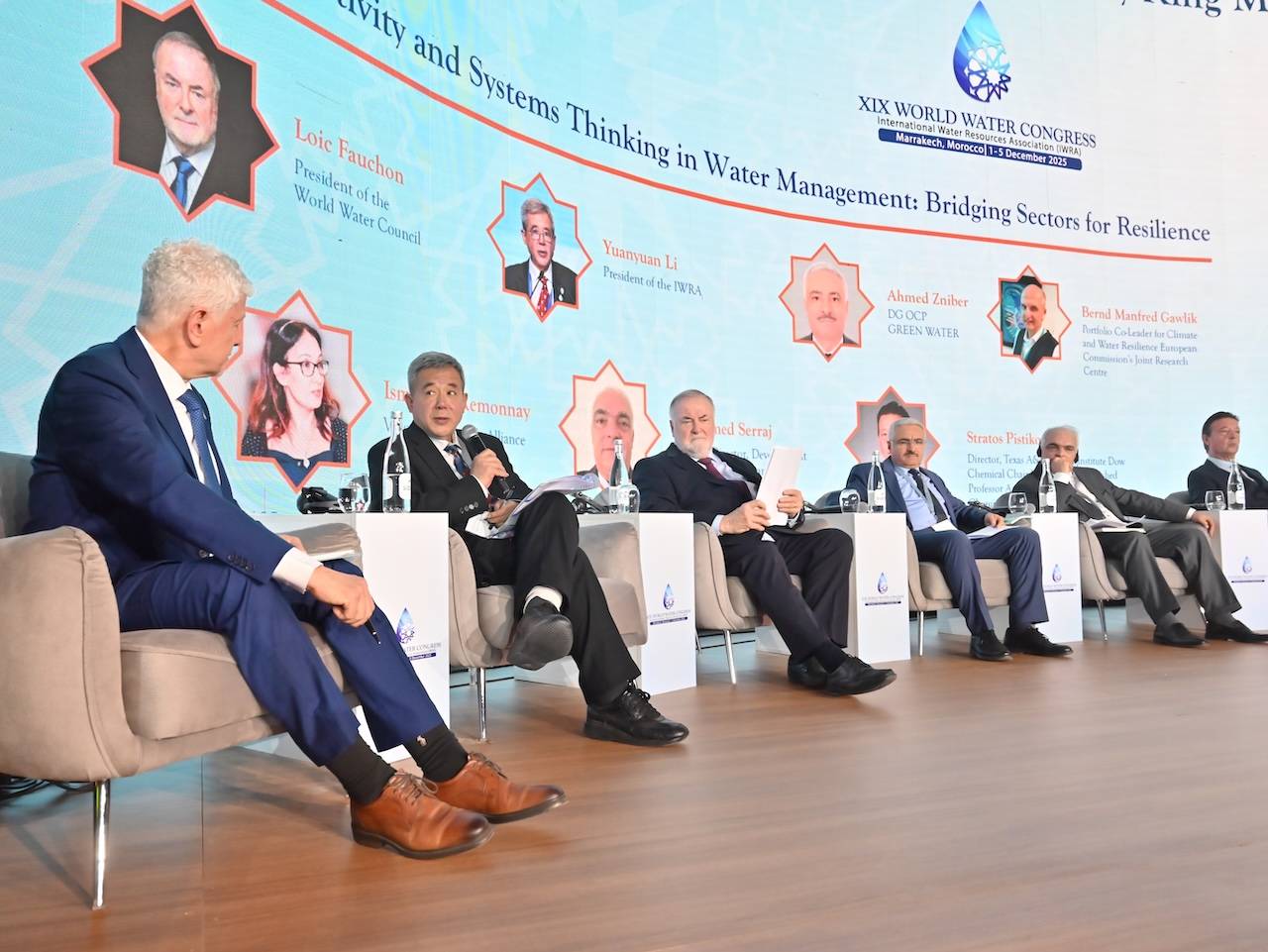
The XIX World Water Congress 2025 took place from December 1 to December 5, 2025, in Marrakech, Morocco | All photos kindly provided by IWRA
As climate change, food security and economic development become ever more closely linked to water, scientific expertise alone is no longer enough. For the International Water Resources Association (IWRA), creating lasting impact means ensuring research informs policy, partnerships and practical action long after a congress has concluded.
Author: Manuel A. Fernandes, HQ Magazine Manager
Water has become central to debates on climate resilience, public health, energy, agriculture and economic development, making effective resourc governance one of the defining challenges of the 21st century. Addressing issues of such complexity demands more than scientific excellence; it requires organisations capable of connecting research with policy, bringing together institutions that rarely operate within the same space and creating opportunities for evidence to guide real-world decisions. For more than five decades, IWRA has sought to fulfil exactly that role. The association has grown into an independent international network bringing together more than 5,500 members and a wider subscriber community of over 12,000 professionals across around 160 countries. Its membership spans academia, governments, river basin organisations, utilities, multilateral institutions, the private sector and civil society, reflecting the interconnected nature of global water challenges.
 For Ignacio Deregibus (right side), Executive Director of IWRA, that breadth is precisely what distinguishes the organisation. “IWRA’s unique value lies in its ability to bridge science, policy and practice through a truly global, independent and interdisciplinary network.” IWRA does not promote specific political positions. Instead, it provides a neutral platform where scientific expertise, practical experience and policy priorities meet. Its objective is to support informed discussion and practical solutions while preserving the independence on which its reputation depends. As water issues become increasingly linked to climate change, biodiversity, food systems and economic resilience, Deregibus believes the need for independent, evidence-based dialogue will continue to grow. “Our ambition is not to become the largest organisation in the water sector, but to remain one of the most trusted global platforms where people come together to strengthen the future of water through informed dialogue, collaboration and action.”
Maintaining credibility requires a careful balance between relevance and independence. As scientific associations take a more visible role in international policy discussions, IWRA avoids acting as an advocacy organisation. Its role is to create the conditions for sound research to inform policy choices. “We do not seek to shape policy through advocacy alone; we have created the global forum where science, policy and practice meet, enabling informed decisions that can lead to tangible improvements in water governance and sustainable development.” The World Water Congress is the association’s flagship event and, according to Deregibus, its main vehicle for creating long-term impact: "Our congress brings together researchers, ministers, United Nations agencies, utilities, financial institutions, civil society organisations and young professionals to exchange perspectives rarely represented in the same forum.

For IWRA, the success of a congress is measured less by attendance figures than by the collaborations and initiatives that emerge afterwards. “We see our role not simply as organising congresses, but as creating lasting impact by connecting scientific excellence with policy dialogue and practical implementation.” Researchers and policymakers often work on different timescales and communicate in different ways. Science must account for complexity and uncertainty, while decision-makers need timely, practical evidence to inform policy. IWRA acts as an intermediary, making rigorous research more accessible without compromising its integrity. “Ultimately, our ambition is to ensure that scientific excellence does not remain within academic circles but contributes to real-world decisions.”
Communication is central to the association’s strategy. Deregibus believes that credibility depends on producing robust science and ensuring reliable information reaches those able to turn it into action. “Communication is no longer simply about sharing information; it is about creating understanding, building trust and enabling action.” Through publications, webinars, specialist reports and digital engagement, IWRA extends the discussions begun at its congresses, allowing learning to continue after delegates leave. Membership reflects the same principle. At a time when information is readily available, Deregibus argues that the value of a professional association lies less in accessing knowledge than in helping to shape it. “The value of membership today is no longer defined by access to information alone. Knowledge is available almost everywhere. What cannot be replicated online is meaningful engagement, trusted relationships and the opportunity to help shape the global water agenda.”
IWRA encourages this engagement through its Geographical Chapters, Task Forces, World Water Envoys Programme, mentoring initiatives and specialist publications. Members contribute to scientific committees, collaborative projects and congress programmes, helping advance the discussions that influence the sector. “Membership today is about belonging to a global professional community rather than simply accessing information.” Managing a diverse international network requires balancing regional priorities with shared global concerns. Water issues vary significantly across regions, but many stem from common pressures, including climate change, rapid urbanisation and population growth. Deregibus sees IWRA’s ability to recognise these differences while encouraging shared learning as one of its strengths. “We recognise that water challenges are always local, but they are increasingly shaped by global trends such as climate change, population growth, urbanisation and geopolitical uncertainty.”

The World Water Congress is where this approach becomes most tangible. Its programme is designed to place researchers alongside those responsible for setting policy and managing water resources, bringing different areas of expertise into the same sessions. As Deregibus explains, “Our scientific programme is developed to encourage interdisciplinary discussion and to place researchers alongside decision-makers in the same sessions.” High-level panels, ministerial dialogues, technical sessions and networking events provide different settings for these exchanges, with participants ranging from government representatives and UN entities to academics, river basin organisations, utilities, financial institutions and young professionals. “High-level panels, ministerial dialogues, technical sessions and networking events create multiple entry points where evidence, experience and policy priorities can intersect.”
For IWRA, the work is not judged solely by the quality of the presentations or the number of people attending. Declarations, policy recommendations, scientific publications and collaborative initiatives can all carry discussions beyond the congress, while the relationships established between participants may provide the basis for further work. “The impact of a congress is therefore measured not only by the quality of the scientific presentations, but by the collaborations, partnerships and initiatives that emerge afterwards.” This is also why the association places such importance on what happens after delegates leave. “One of the key lessons IWRA has learned over decades of organising World Water Congresses is that lasting impact comes from sustained dialogue rather than one-off events.”
Long-term impact also informs host selection. IWRA considers venue capacity and logistics, as well as whether cities and institutions are prepared to use the congress to advance academic cooperation, institutional development and policy innovation. “We are not simply looking for a place to organise a successful international congress; we are looking for partners who want to create lasting impact.” Istanbul will host the XX World Water Congress from 4 to 8 October 2027. Its location between Europe and Asia strengthened the bid, but Deregibus says the decision also reflected the destination’s alignment with IWRA’s long-term objectives. “Associations have a unique responsibility to ensure those two worlds continue to meet.”
Powered by Meeting Media Company, publisher of Headquarters Magazine (HQ) – a leading international publication based in Brussels, serving the global MICE industry and association community.

Since its founding in 1992, Meeting Media Group, publisher of Headquarters Magazine (HQ), has been a trusted guide and voice for associations and the global MICE (Meetings, Incentives, Conferences, and Exhibitions) industry.